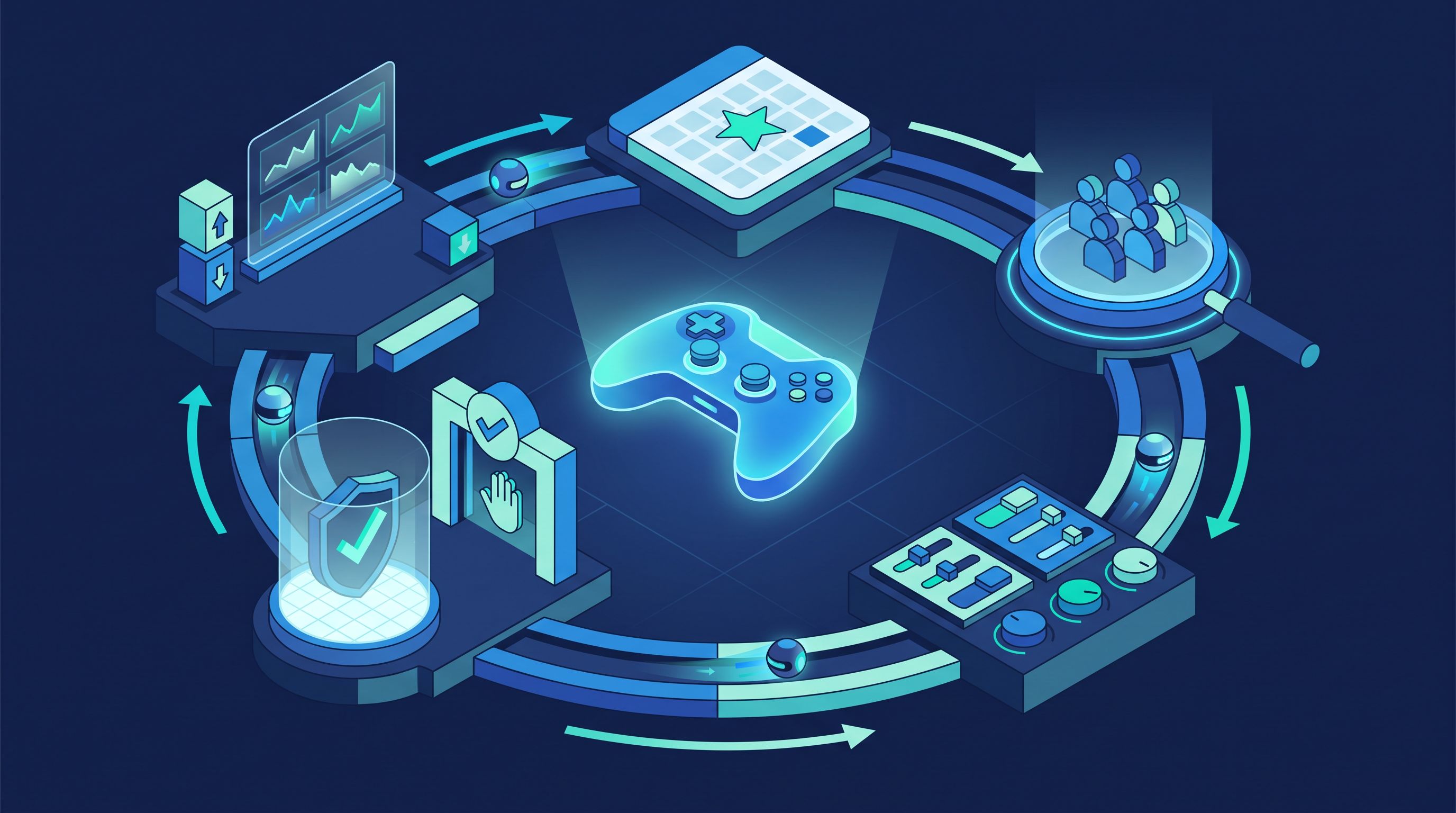
A live game runs on a weekly loop. On Monday someone reads the KPIs: day 1 and day 7 retention, ARPDAU, event participation, currency sources and sinks. Something has dipped, so the team works out which segment, which platform and which build. They pick an intervention (a limited-time event, an offer, a difficulty change on a level that is losing players), configure it in remote config for the right segment, test it, ship it on Thursday, and read the result the following week.
The decision in that loop takes an hour. The hours around it go to writing queries, reconciling dashboards, filling event configuration by hand and checking that the rewards in the build match the spec.
A new survey, AI for Games in the Foundation Model Era (Luo et al., 2026, with a companion paper list), is a good map of what research has to offer that loop. Read with a LiveOps week in mind, it splits into a part that is close to settled and a part that is barely covered.
Prediction is the settled part
Predicting which players will leave has a decade of solid work behind it. Drachen et al. (2016) showed that retention in free-to-play mobile games can be predicted from a player's first session, day and week, with simple heuristics performing comparably to standard classifiers. Periáñez et al. (IEEE DSAA 2016) treated churn as a survival problem and found that survival ensembles give more accurate and more stable estimates than Cox regression. For LiveOps the survival framing matters more than the accuracy gain, because it estimates when a player is likely to leave, and the timing of an event or offer depends on that.
Difficulty can now be predicted before players see a level. Roohi et al. (CHI PLAY 2020), a collaboration between Aalto University and Rovio, used reinforcement learning agents playing Angry Birds Dream Blast to predict level difficulty and churn, and improved the predictions with a population level simulation of players. A team tuning a weekly batch of new levels can screen them that way first.
Matchmaking has been optimized for engagement too. EOMM (WWW 2017) frames matchmaking as maximizing player engagement and reports a significant improvement over existing methods in a simulation on real data from an Electronic Arts game.
Any studio with a data team can build these models, and most large studios have. They tell you who is at risk and which content is too hard. They do not tell you what to ship on Thursday.
The intervention is the uncovered part
The survey has very little on live events, economy tuning, offer design or experiment readouts, which is where a LiveOps team spends most of its week. That gap is also where language model agents are useful today. They do not predict churn better than a survival model. What they handle well is the surrounding work: reading a metric definition, writing the SQL, segmenting a dip, drafting a configuration against a schema and summarizing an experiment.
In practice an agent in the loop does three jobs.
- Diagnosis. With read access to the warehouse, the metric definitions and the event calendar, the agent answers the Monday question ("day 7 retention fell two points on Android last week, why") by running the breakdowns an analyst would run and reporting what it found and which queries it used. Read-only access means a wrong answer costs a re-check and nothing else.
- Configuration drafting. Given a short brief ("a three-day collection event for lapsing mid spenders, rewards from the existing pool"), the agent writes the event configuration and the segment definition, and a validator checks them against the schema and the reward catalogue before a person sees them. We used the same pattern of brief, approval gate and independent verification for the autonomous feature pipeline we built for a live hyper-casual game.
- Readout. When the test ends, the agent computes the result for the metric chosen before launch, with confidence intervals, and writes the summary for the team.
Where a person signs off
The approval line follows reversibility. A wrong analysis costs an afternoon. A wrong price or a wrong currency grant reaches thousands of players within hours, and taking currency back from players costs more goodwill than the original mistake.
So a person approves anything that touches prices, currency grants, economy sources and sinks, or eligibility for paid offers. A person also chooses the success metric before the test starts. An agent handed the results and asked whether the event worked will find some metric that went up, and it will be right about that metric.
Low-risk parameters can run closer to a closed loop once the first two jobs have been reliable for a while: difficulty adjustments within fixed bounds, event scheduling inside an approved calendar, matchmaking weights within a tested range. The bounds are set by a person and the agent works inside them.
Testing the change before it ships
Automated testing is the other area the survey covers well. Gillberg et al. (2023) describe the engineering problems of deploying reinforcement learning test agents in AAA games, including Battlefield 2042 and Dead Space, to increase test coverage. VideoGameQA-Bench (Taesiri et al., 2025) evaluates vision language models on glitch detection, visual regression and bug report generation, and is the best current reference for how far that approach goes.
The test a LiveOps change needs is narrower than full game QA. Does the event configuration load in the current build? Do the rewards granted match the spec? Does a simulation of the economy over the event window stay within the bounds the team set? These checks can be fully automated, and they are the ones that catch the expensive mistakes.
Where to start
Start with the Monday diagnosis, read-only, on the metrics the team already trusts. It shows within a few weeks whether the agent's analysis matches what the analysts would have found, at no risk to players. Configuration drafting with schema validation comes next. A closed loop on bounded parameters comes last, and prices and currency stay with a person throughout.
Working with Vindler
Vindler builds AI systems for game studios, including LiveOps analytics agents, configuration pipelines with validation and approval gates, and automated testing for live content. If you run a live game and want to talk about which parts of your weekly loop to automate, book a call.
References
- Luo, M. et al. (2026). AI for Games in the Foundation Model Era. Companion list: awesome-ai-for-games.
- Drachen, A. et al. (2016). Rapid Prediction of Player Retention in Free-to-Play Mobile Games.
- Periáñez, Á., Saas, A., Guitart, A., Magne, C. (2016). Churn Prediction in Mobile Social Games: Towards a Complete Assessment Using Survival Ensembles. IEEE DSAA.
- Roohi, S., Relas, A., Takatalo, J., Heiskanen, H., Hämäläinen, P. (2020). Predicting Game Difficulty and Churn Without Players. CHI PLAY.
- Chen, Z. et al. (2017). EOMM: An Engagement Optimized Matchmaking Framework. WWW.
- Gillberg, J. et al. (2023). Technical Challenges of Deploying Reinforcement Learning Agents for Game Testing in AAA Games.
- Taesiri, M. R. et al. (2025). VideoGameQA-Bench: Evaluating Vision-Language Models for Video Game Quality Assurance.