

And what it takes to run one.
US searches for "software factory" over the last three months ran about nineteen times higher than a year earlier, according to Google's Keyword Planner. The pages that rank for it come from Factory.ai, Augment, Sonar, Qodo, Mastra and Vercel, with BCG Platinion and a Gartner note alongside. They agree on the outline: coding agents take tickets, write the code, test it and open a pull request, and people set intent and approve what ships.
The term is older than any of them. In 1968 R. W. Bemer proposed that General Electric build a "software factory", meaning a standard environment and tooling that made programming repeatable. The 2026 version keeps the idea and replaces most of the people on the line with agents.
We build agent systems for clients and run our own operation on scheduled agent jobs, so this post skips the definition contest and goes to the parts that decide whether a factory works.
A working definition
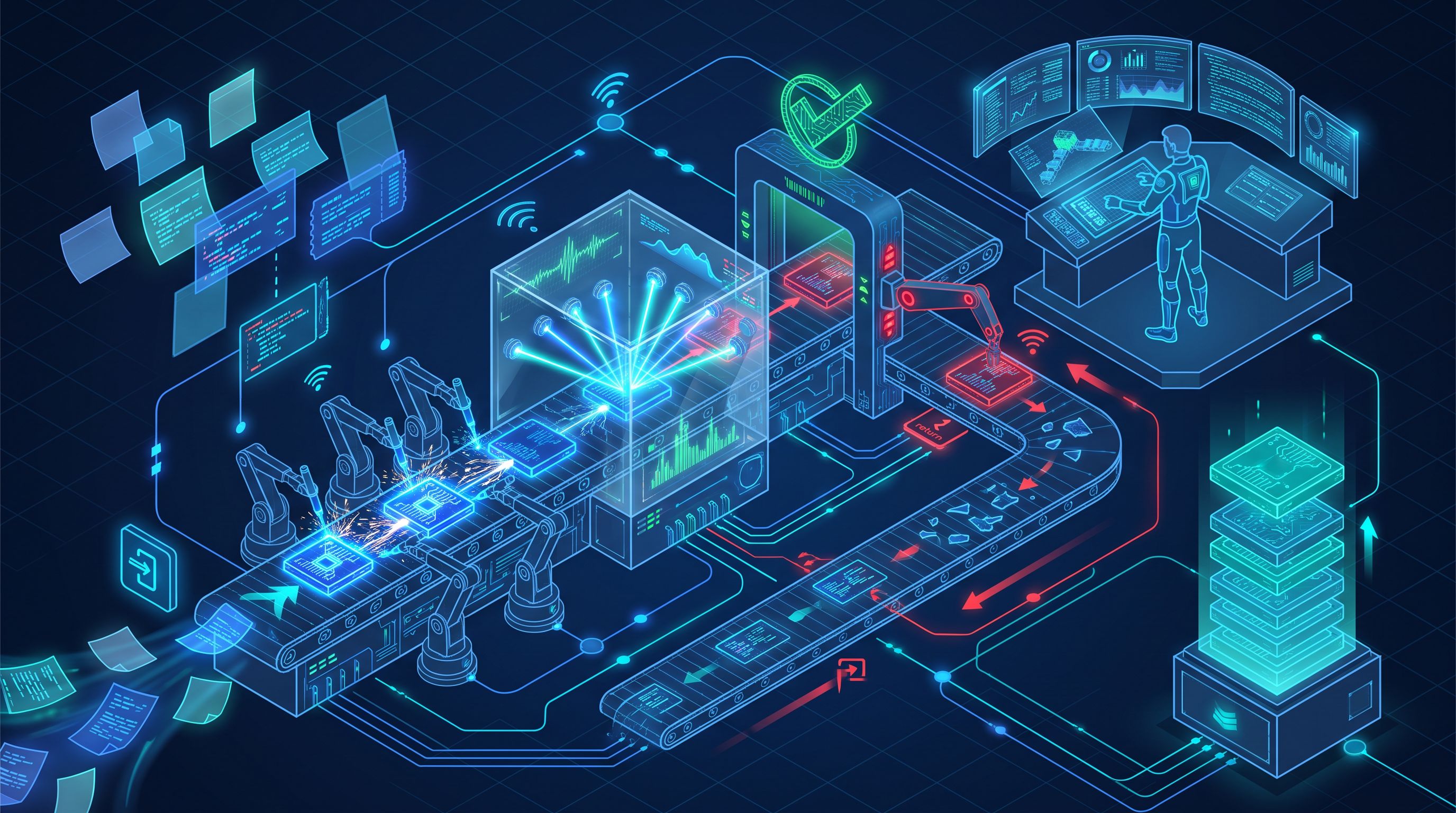
An AI software factory is a delivery system in which coding agents take a unit of work from a ticket to a pull request, checks the agents do not control decide whether the change is correct, and people decide what merges and what ships.
Three roles sit in that sentence, and the whole design follows from keeping them apart. The agent that writes a change never grades it. The check that grades it is code, a test suite, an evaluation or a second agent with its own instructions and no stake in the first one's output. The person at the end decides, and gets evidence to decide with.
Augment's description is close to this: agents write, test and ship, with specs and merge approval kept under human control. Sonar's adds that people set the constraints and the approval policy. Where the vendor pages go quiet is on what happens between the agent finishing and the person approving, which is where most of the engineering is.
Why licences alone do not get you there
Most engineering teams already pay for Claude Code, Cursor, Codex or Copilot. What we usually find is one setup per engineer, an agent that waits for someone to type, and a review queue that grows because nobody trusts what the agent wrote. Output goes up a little, and the bill and the review load go up with it.
Search data shows the same shift. Searches for Claude Code tips and features are down over the year while searches for "agentic engineering", "harness engineering" and "software factory" are up several times over. The question has moved from how to use the tool to how to run it across a team.
Gartner put it bluntly in September: without a factory around them, capable agents stay trapped inside a slow, human-coordinated delivery process. That matches what we see. The agent is rarely the bottleneck. The process around it is.
The parts of a factory
Repositories agents can work in
Every repository the factory touches needs instructions an agent reads before it acts (a CLAUDE.md or AGENTS.md), and someone who owns them. A shared skill library means a fix to how agents run your migrations reaches every engineer at once. Agents run in a sandbox with scoped credentials, and there is a single switch that stops all of them.
This is unglamorous and it is the stage most teams skip. Martin Fowler's site calls this layer the harness: guides that steer the agent before it acts and sensors that check what it produced. A strong model in a weak harness produces confident, wrong pull requests.
Loops instead of prompts
The factory runs agents without a person typing. A schedule or an event starts a run: a new ticket with a certain label, a failing nightly build, a dependency release, a weekly sweep. Each run has a bounded scope and ends on a condition a machine can check. The design of these cycles is what people now call loop engineering, and we cover it in its own post, Loop Engineering in Production.
Verification the agent does not control
This is the part that separates a factory from a fast way to produce bugs. Qodo makes the point in its own explainer: a factory that builds quickly without checking its output only produces problems faster.
Useful checks look at the end state. A test that the feature works in the running product, a browser run that clicks through the flow, an evaluation suite that scores the output, a type check, a security scan. A check that reads the agent's own summary of what it did is not a check. In our client work the most common failure we fix is an agent that reports a task as done when the product disagrees, and the only reliable cure has been a check that asks the product.
Review gates in CI
Review is where agent output piles up. Two things help. One review rubric that runs on the engineer's machine and again in CI, so the same standard applies whether a person or an agent wrote the change. And a bounded review loop: blocking issues get fixed or explained, minor comments stay minor, and the loop stops after a set number of passes. Without the bound, an agent reviewer and an agent author can trade comments indefinitely.
Cost and control
Each loop needs a budget and a spend record per run, so a loop that starts burning tokens on a hard case is stopped by a limit and not by an invoice. Spend per tool and per team tells you which loops pay for themselves. Every agent action goes to an audit trail with the person who approved it.
A step that learns
The better factories keep a trace of every agent call and turn failures into new test cases and better instructions. A failed run that leaves nothing behind gets repeated next week.
The number that decides scale
Factories fail in a predictable way: they scale before anyone knows whether the changes hold up. The measure we put at the centre is the share of agent changes that get reverted or reworked after merge. While it stays low, a loop earns more scope, more repositories and fewer human checks. When it climbs, the loop goes back to a narrower task.
Around it sit a handful of supporting measures: merged changes per loop, review time per change, cost per merged change, and engineer hours that went back to other work. Vendor claims of three to five times more output, such as BCG Platinion's, are worth testing against your own numbers before they go into a budget.
Where to start
Teams move through three stages, and each one has a gate.
- One loop, one check. Pick a task where a machine can say pass or fail: a lint rule, a failing test, a dependency bump. Run a single agent loop on it. The aim is to learn what your repositories are missing.
- Repositories agents can work in. Instructions per repository with an owner, shared skills, sandboxing, a review gate, spend limits and a stop switch.
- Packaged loops. Scheduled and event-driven runs with a maker agent and a separate checker, connected to your tracker and chat, scaled one loop at a time while the revert rate holds.
Good first candidates are the jobs engineers put off: framework and dependency upgrades across many repositories, flaky test repair, triage of incoming bugs against known areas of the code, accessibility fixes, and migrations with a clear before and after.
Removing human review for a category of change comes last, and only once the tests for that category are good enough that you would trust them without the person.
How we help
We help engineering teams get from licences to a working factory: an assessment of where each team sits and what its repositories are missing, then the first packaged loop built on your code with its checks and its approval step. The details are on our AI software factory page. If you are comparing firms that roll out Claude Code, our comparison of Claude and MCP rollout partners lists what to check, us included.
Sources
- The agentic software factory, BCG Platinion.
- Gartner insight abstract, September 2026.
- What is a software factory, Augment Code.
- What is an agentic software factory, Sonar.
- Software factory, Factory.ai.
- Shining some light in dark agentic software factories, Xebia.
- Harness engineering for coding agent users, Birgitta Böckeler on martinfowler.com.
- How to scale agentic coding across your engineering organization, Anthropic.