

Leading the AI-Driven Organization at MIT Sloan: A Review from Inside the May 2026 Cohort
In May 2026 I spent a week at MIT Sloan on a programme called Leading the AI-Driven Organization. Five days in Cambridge, Massachusetts, USD 12,900 in tuition, plus flights from São Paulo and eight nights in a hotel. My name is Carlos Dutra and I founded Vindler Solutions, where I build AI systems for a living. That is precisely why I did not go to learn about AI.
I went to find out what a room full of people who run large organisations thinks about what AI is doing to those organisations. That turned out to be the right reason to go.
One thing worth saying before anything else. When I looked for a firsthand account of this programme before enrolling, I could not find one. Every page on the internet that answers "is it worth it" for this course appears to have been written by somebody who did not attend it, and at least one of them has the price wrong. So here is the account I wanted to read, written by someone who sat in Room 176 for all five days.
Who Was Actually in the Room
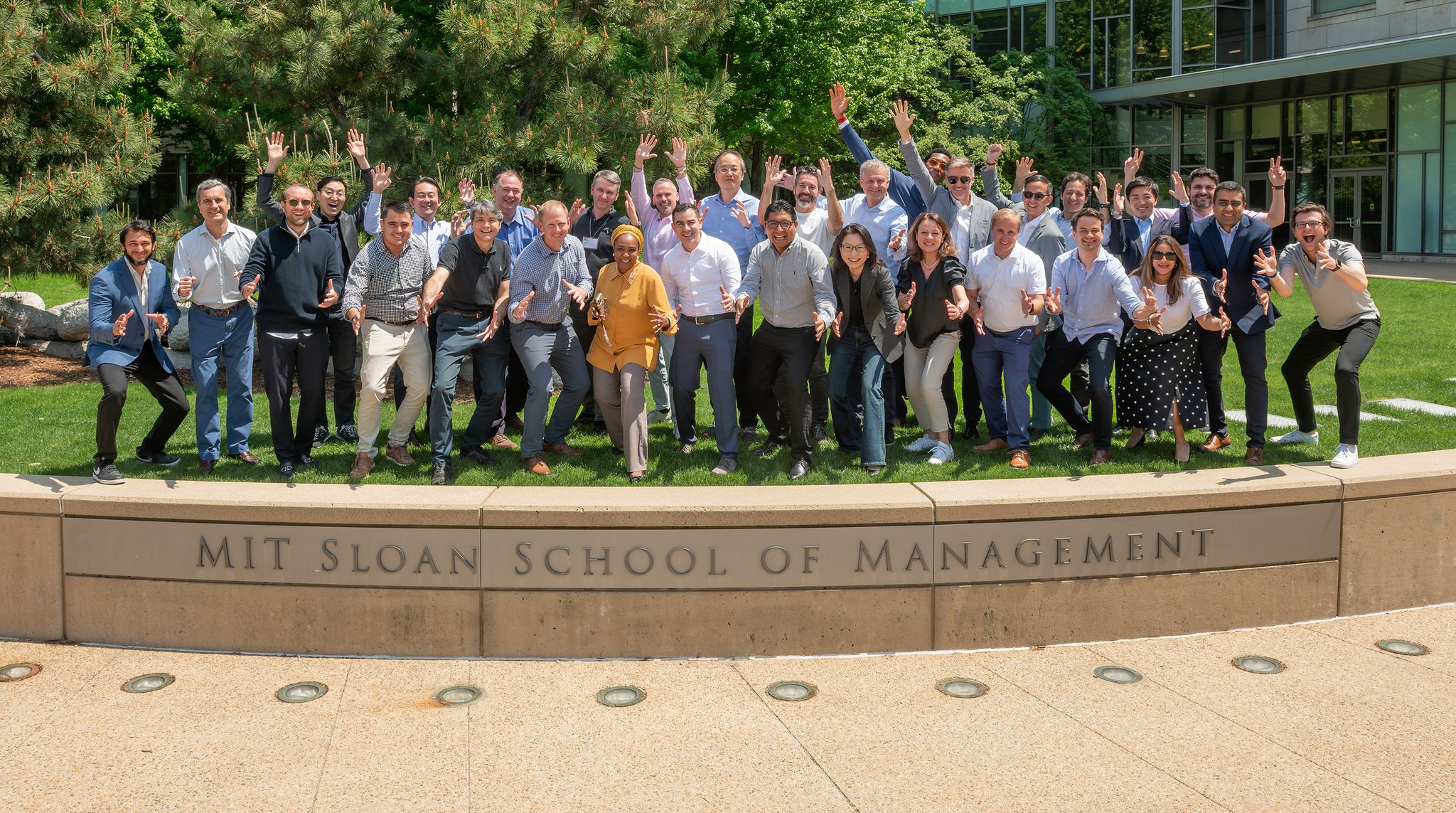
There were twenty-nine of us.
The titles tell you most of what you need to know: chief executives, chief strategy and transformation officers, a chief risk officer, a chief technology officer, chief people officers, executive vice presidents, partners at consulting firms and venture funds, and national regulators.
The sector spread was wider than I expected: energy and utilities, defence, heavy industry and infrastructure, automotive, payments, healthcare, consumer goods, telecoms, Japanese trading houses, and academic research on AI.
The geography was wider still. Twenty-nine people based in eleven countries across five continents, and that changed the character of every discussion. The same question about automating a workflow produces different answers depending on whether you are operating under European labour law, inside a US federal agency, or in a market where basic infrastructure is the binding constraint. Sitting at a table in Cambridge with Nigeria, Japan, Poland, Germany, Austria, Spain, France, the United Kingdom, China, the United States and Brazil all represented does something that reading about global AI adoption does not. You stop treating your own operating context as the default case.

That mix is the product. I have been to plenty of AI events where everyone in the room does roughly what I do, and the conversation converges fast because the assumptions are shared. This was the opposite. When you explain an agent architecture to someone responsible for the reliability of a national power grid, you find out very quickly which parts of your thinking are load bearing and which parts are just familiar.
Six of the twenty-nine were Brazilian, including me. That is more than a fifth of a global cohort, and they were there at chief digital officer, vice president and chief executive level. I did not expect that, and it was the best surprise of the week. It also sharpened something I already believed, which is that Brazil has a reputation for innovation that its actual AI adoption has not yet earned. The people are in the room. The implementations are behind.
I should also say that one of the defence guys handed me a challenge coin at the end of the week. It is on my desk. Five days of arguing about org charts with people whose problems are nothing like yours turns out to be an unreasonably good time.
The Question Most Executives Are Asking Backwards
The single most useful reframe of the week had nothing to do with technology.
Most executives evaluate AI the way they evaluate any capital allocation. What is the return, over what horizon, against what baseline. That framing is not wrong exactly, but it quietly assumes the baseline is stable. It assumes that if the investment does not clear the hurdle rate, you keep what you have.
The better question is what it costs you to stand still while a competitor ships a better product with a smaller team. Framed that way, most AI programmes stop being growth bets and start being insurance against obsolescence, and the internal politics change completely. A growth bet competes with every other growth bet and usually loses to the one with a cleaner spreadsheet. An avoided loss competes with nothing.
What the week kept returning to was the distance between what companies say about AI and what they have actually put into production. Almost every organisation represented in that room had public messaging about AI. A much smaller number had anything running that changed how work got done. That gap is not a technology problem and no vendor will close it for you. It is an organisational design problem, and it is the reason I now spend as much time on operating models with clients as I do on architecture.
When the Org Chart Stops Being a Chart
The idea I keep coming back to came from Paul Cheek, who led the week: an organisation is better understood as a set of nodes working toward a shared purpose than as a hierarchy of people. He has built a fuller framework on top of that definition, and it is his to publish rather than mine to summarise, so what follows is only what I did with the definition after I had it. Accept it, and the question of whether a node is a person or a system becomes a design decision rather than a philosophical one, while the org chart starts looking like a network where work flows to whoever, or whatever, can contribute.
That sounds abstract until you try to answer the operational questions it creates. The week put most of them in front of us directly, and the honest position, in that room and outside it, is that almost nobody has answers yet. When an agent makes a decision that turns out to be wrong, whose performance review reflects it, and who had the authority to override it before it shipped? Who approves a new agent, given that it looks like software to procurement and behaves like an employee to human resources? Agents are an operating expense rather than headcount, so which budget line are they on, and who defends it? If your agent stack is unavailable for forty eight hours, what actually stops?
The question I found hardest is about people. If an agent writes every first draft, your juniors never learn to write one. You have not saved time, you have broken the ladder that produces your future seniors, and you will not notice for about three years.
The counterweight came from the faculty, and it was the most reassuring thing I heard all week. Every professor we raised this with said a version of the same thing. They spend their days surrounded by thousands of young engineers who are building more, building it faster, and learning faster than any cohort before them, specifically because of these tools. Not one of them was worried about those students struggling to find a place in the market. What they saw was strong engineers doing engineering, now with better instruments.
I have been holding both of those ideas since. MIT is not a random sample of the workforce, and what its students have in abundance is exactly the habit that the research further down this post says separates the people who gain from AI from the people who do not. But it does suggest that the tools are not what breaks the ladder, and that the break happens when they reach people who were never taught the work underneath them. I do not have a clean answer beyond that. I have started asking every client about it.
What the Hands-On Work Looked Like
The programme is not a lecture series. A meaningful share of the week was spent working directly with AI tools on our own situations rather than watching slides about them.
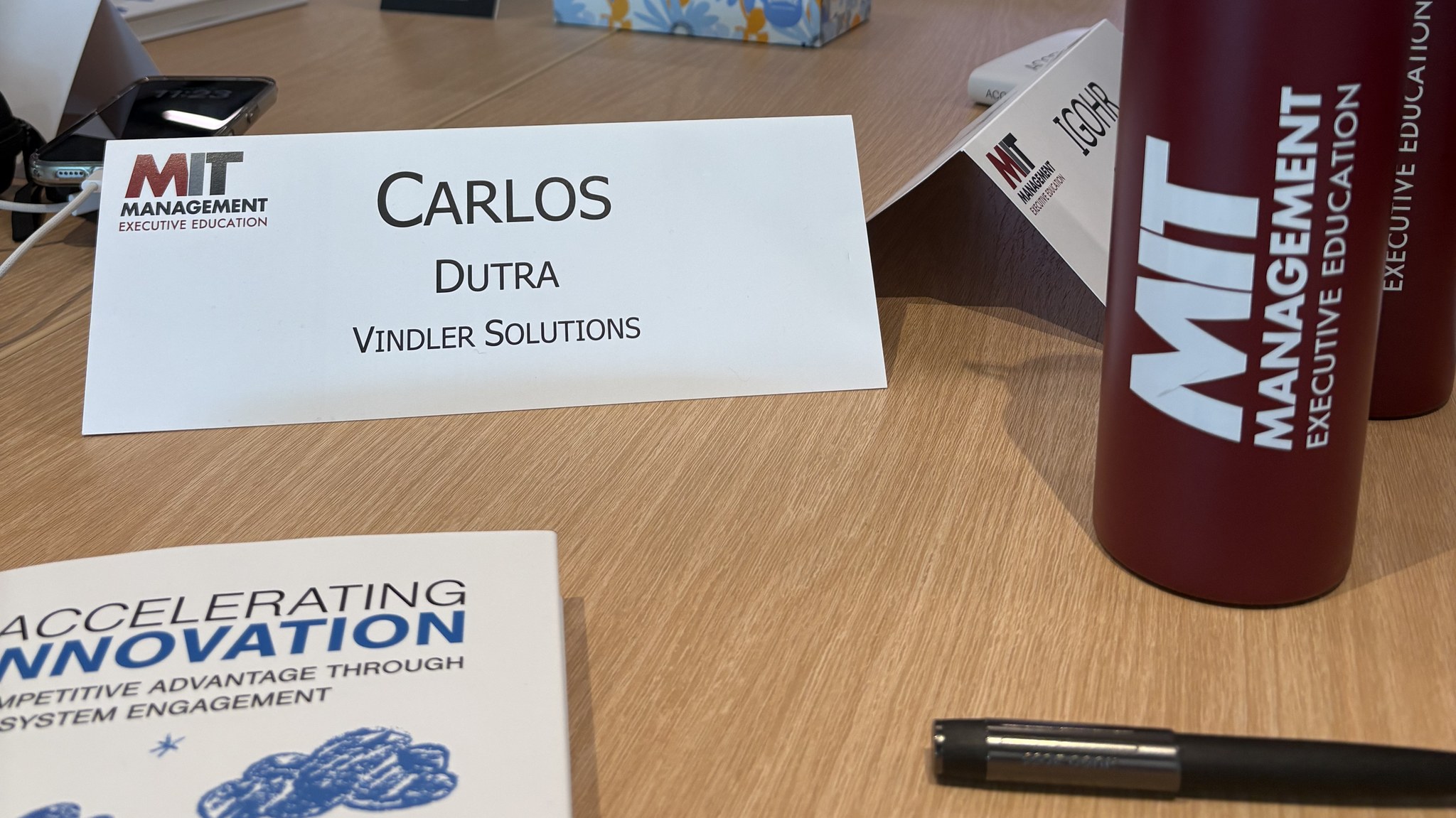
I should be honest about my starting point. I build with these systems every day and have done for years, so almost none of the tooling content was new to me. What I did not expect was that those hours would end up among the most useful of the week anyway, for a reason that had nothing to do with the material.
Sitting beside executives who are not technical while they work with AI in real time is something I had never done at length. I spent those sessions watching how they approach it. What they assume the system can and cannot do. Where their mental model breaks. Which failures alarm them and which they shrug off. What they quietly abandon rather than attempt a second time. More than once I ended up helping the person next to me get something working, and that was the most direct product research I have done in a year.
It has changed how I advise. Most of what stops AI adoption inside a company has little to do with model capability, and a great deal to do with the distance between how the person who designed a workflow expects it to be used and how a busy executive actually uses it between two meetings. You only see that gap by sitting next to someone while they try.
Three things from those sessions are worth passing on, and they are the ones I now repeat to clients. The first is that most of the value comes from context rather than phrasing. Getting an AI system to produce work you would actually sign your name to is mostly about what it can see, which means your documents, your standards, your history, your decisions. The clever prompt is a rounding error next to that.
The second is the persona exercise. Spending a couple of hours writing down how you actually communicate, including what you would never say, and then giving that to the AI, removes more editing work than any other single thing I have seen an executive do. It is unglamorous and it takes an afternoon. It is also the highest return two hours available to most leaders right now.
The third is the security lesson, and it is the one the room found uncomfortable. Anything your AI assistant can read, it can be instructed by. An inbox connector is not a search index over your mail, it is an instruction stream open to anyone who knows your email address. We watched this happen live rather than reading about it, and the effect on a room of senior executives who had spent the previous two days enthusiastically connecting tools was memorable. You would not let a new hire execute arbitrary tasks emailed in by a stranger. Plenty of organisations are doing exactly that, faster, and calling it productivity.
The governance conclusion follows directly. Your system prompts, your connector inventory and your persona files are governance artifacts. They belong on a risk committee agenda, not in an engineer's local configuration.
The Research That Changed How I Think About Hiring
Thursday was three hours with Professor Jackson Lu on the benefits and costs of using generative AI, drawn from a review of more than four hundred studies. It was the most academically rigorous part of the week and the part I have quoted most often since. Three findings in particular have stayed with me. Every study I describe below is published and linked here, and where I draw a conclusion the research itself does not state, I say so.
There is a measurable ability to work with AI, and it is not intelligence
Lu and his coauthors have a working paper on what they call the Artificial Intelligence Quotient, or AIQ, defined as a person's ability to use AI to accomplish a wide range of tasks. Across five studies, including an eighteen year global dataset of human plus AI chess tournaments and a longitudinal study of human plus AI game play, they find that individual performance when working with AI is stable over time even after controlling for the person's own capability and the AI's capability. They then extract a general AIQ factor from performance on varied tasks completed with ChatGPT, and show it predicts how well the same person will do later on new tasks using different AI systems.
The part that matters for anyone hiring is what they controlled for. AIQ holds up independently of IQ, social intelligence, AI literacy and computer literacy. It is not a proxy for being clever and it is not a proxy for knowing things about AI. There is a distinct and apparently stable human capability for producing good work with a machine, and the usual signals on a CV do not detect it.
A related field experiment by Lu and colleagues, published in the Journal of Applied Psychology, gives you a sense of what that capability is made of. Around 250 employees at a technology consulting firm were randomly assigned access to ChatGPT for a week. Creativity ratings went up, from both supervisors and independent external evaluators, but the gains were concentrated almost entirely among employees who scored high on metacognitive strategies, meaning the people who plan a task deliberately, track their own progress against it and adjust their approach as they go. Employees who do not work that way got very little. As Lu puts it, "Generative AI isn't a plug-and-play solution for creativity."
That reframes the hiring question. I have stopped asking candidates which AI tools they use, because the answer is now the same from everyone and it predicts nothing. What I ask instead is how they broke down the last hard problem they worked on, how they knew their first approach was wrong, and what they changed. People who can narrate their own process are the ones who get value out of these systems. The encouraging part is that metacognition appears to be trainable, so this is a development question as much as a selection one.
Creativity goes up individually and down collectively, unless you change the architecture
The most counterintuitive result of the week is that AI can make every individual in your organisation more creative while making your organisation less creative.
The evidence for the first half is solid. In a study published in Science Advances, writers given AI generated story ideas produced work rated as more creative, better written and more enjoyable, with the largest gains going to the writers who started out weakest. Elsewhere the same pattern shows up for non-experts and for people working in a second language, which as a Brazilian working in English I take some personal satisfaction in.
The second half is the problem. In that same study, the AI assisted stories were measurably more similar to one another than the human only stories. The mechanism is anchoring. People take the AI's first suggestion as a starting point, and if everyone on your team is anchoring on their own private assistant, all of them drift toward the same centre. The authors describe it as a social dilemma, which I think is exactly right. Everyone is individually better off and the collective output space quietly narrows.
Here is the connection I made during the week, and I want to be clear that this is my reading of two studies placed side by side rather than something the course claimed. The homogenisation happens when each person has a separate AI with a separate context. When the AI instead carries context between people, the result looks different. In a field experiment with 776 professionals at Procter and Gamble, individuals working with AI matched the performance of two person teams working without it, and the AI dissolved functional silos: without it, research people proposed technical solutions and commercial people proposed commercial ones, while with it both groups produced balanced proposals regardless of background. The AI was carrying the other function's context into an individual's work. Teams using it were also more likely to produce solutions in the top decile.
So the design question is not whether to give people AI. It is whether the AI sits inside each person's private workflow, where it averages everyone toward the same output, or between people, where it moves context across boundaries that humans have historically been bad at crossing. That is an architecture decision, and most organisations are making it by accident.
The costs are social, and they are the ones nobody budgets for
The last part of the session was about what AI adoption does to how people treat each other, and it was bleak in a useful way.
Start with what has been named workslop, meaning AI output that looks polished but carries no substance, which quietly transfers the actual thinking to whoever receives it. In a study of 1,150 employees, 40 percent had received workslop in the previous month and spent roughly two hours untangling each instance. The finding that stopped me was the social one. Recipients rated the sender as less capable, less reliable and less intelligent. The tool that makes you look productive can quietly make your colleagues think less of you.
Part of that session drew on research that is not yet published, and I am leaving it out rather than summarising work its authors have not released. Everything below is in the open literature.
The cost is also distributed unfairly. In research covering more than a thousand engineers reviewing identical code, reviewers told the code was AI assisted rated the author 9 percent less competent on average. For women the penalty was 13 percent, more than double the 6 percent applied to men. A separate study in PNAS with 4,439 participants found AI users were seen as lazier and less competent and were disfavoured in hiring. Using AI appears to confirm doubts people already hold, which means the colleagues who already face the most scepticism pay the highest price for using the same tool as everyone else.
Then there is learning. One PNAS study found a group using GPT-4 improved 48 percent during practice and then scored 17 percent worse than the control group on a closed book exam taken without it. An MIT Media Lab EEG study found that participants writing with an LLM showed the weakest neural connectivity of any group and were the least able to recall what they had just written under their own name.
None of this is an argument against AI, which would be a strange position for me to hold. It is an argument that the costs are social rather than technical, and that they are mostly avoidable if you are deliberate about three things: where AI output gets a human review before it reaches a colleague, how people get credit for work done with these tools, and whether anyone still has protected time to think before reaching for the assistant.
When I shared a version of this with a director of AI engineering at a client after the course, the reply was that workslop described exactly what she had been feeling for weeks. She took it into her research and development offsite. That is the reason I am writing it down here.
MIT Sounds Different From Silicon Valley
The thing that surprised me most about the week was the tone.
A high proportion of the programme was spent on risks and negative consequences. Cybersecurity and terrorism. Climate and energy, which had its own Friday morning session. Economic and geopolitical effects. Cognition and learning. Governance had a dedicated block of its own.
I travel to the United States west coast regularly and the conversation there has a different centre of gravity. It is about capability, velocity and what becomes possible next. At MIT the same technology was discussed by people whose job is to study consequences, and the room reflected that. I do not think one framing is correct and the other naive. I think an executive making a five year commitment is better served by the second, and I did not expect to write that sentence.
Was It Worth USD 12,900?
For me, yes, with conditions.
The schedule is dense and efficiently built. Breakfast at 8:15, sessions from 9:00, finishing between 5:15 and 5:45, with the last forty five minutes of every day reserved for structured reflection rather than more content. That reflection block is the reason the week compounds instead of blurring, and I would have cut it if I had designed the programme, which is a good argument for not letting me design programmes. There was a networking reception on Monday and a dinner on Thursday. It is a full week and you will be tired.
The curation is the real value. The week was led by Paul Cheek with Paul McDonagh-Smith, and the faculty around them across five days included a CSAIL researcher on what the technology actually is, a researcher from MIT's centre for information systems research on treating data as everyone's responsibility, MIT's innovation ecosystem leadership on deep technology, an organisational psychologist on the human costs, a sociologist on adoption mechanics, a specialist on responsible AI and governance, and a researcher on climate and energy consequences. Infrastructure through to society in one week, with no vendor pitch anywhere in it. I have not seen that range assembled anywhere else, and you cannot assemble it yourself.
Now the honest part, because a review that only praises is not a review.
This is not a technical programme. You will not leave able to build anything you could not build before. If you are an engineer hoping to deepen your implementation skills, spend the money on one of MIT's professional education courses instead and you will be much happier. I build these systems for a living and the organisational content was valuable to me precisely because it was the part I could not get from doing the work.
The daily social posting prompts are part of the programme design. Each day has a suggested theme, hashtags and accounts to tag. It is a reasonable trade, since it does help the cohort get to know each other's thinking, but you should know going in that amplification is built into the week.
The cohort is a real variable. Mine was exceptional and I have kept in touch with a good number of them since. That is partly MIT's admissions and partly luck, and no review can promise you the same room.
So the short version. Take it if you carry responsibility for how an organisation adopts AI, and you want to pressure test your thinking against people carrying the same responsibility in industries nothing like yours. Do not take it if you want to learn how the technology works, if you need a specific deliverable rather than better questions, or if a week away from operations is not realistic right now.
What I Took Home
I came back from Cambridge more optimistic about AI than when I left, and considerably more careful about how I talk to organisations about adopting it.
The technical questions I was already equipped for. What changed is that I now spend more of my client conversations on the parts that are not technical at all: what work should stay stubbornly human, who owns the outcome when a system makes the call, how you hire for the ability to work with these tools rather than the ability to name them, and how you avoid the quiet social costs that show up in a team six months after the tooling budget was approved.
Those turn out to be the questions that decide whether an AI programme succeeds, and almost none of them are answered by choosing a better model.
If you are working through any of this inside your own organisation, I am happy to talk. And if you are deciding whether to spend the USD 12,900, I hope this was the account I could not find.
Written in São Paulo, 30 July 2026. Carlos Dutra is the founder of Vindler Solutions and completed Leading the AI-Driven Organization at MIT Sloan Executive Education in May 2026.