
The Engineering Behind Clawdbot: Architecture, Protocols, and Trade-offs
A technical deep-dive into the most hyped personal AI agent of 2026
Clawdbot is a well-engineered orchestration layer, not a technological breakthrough. The innovation is in product vision, not architecture. If you're building agents, the real lessons are about integration quality and the "AI comes to you" paradigm shift.
The Hype Machine
My Twitter feed has been insufferable lately.
"Bought a Mac mini just for Clawdbot. Incredibly addicting."
"Cleared 10,000+ emails from my inbox. Less than 24 hours in."
"This is Jarvis. It already exists."
"Sort of amazing knowing that we are all having the same weekend... Mac Minis & Clawdbot."
Federico Viticci called it "the most fun and productive experience I've had with AI in a while." Dave Morin wrote: "This is the first time I have felt like I am living in the future since the launch of ChatGPT." People are literally buying hardware just to run it, despite the creator begging them not to.
As someone who's been deep in multi-agent frameworks for the past year, building voice assistants with LiveKit, experimenting with LangGraph pipelines, and running my own AI infrastructure on a Raspberry Pi, I needed to understand what was actually going on here.
Is Clawdbot a genuine leap forward? Or is 2026's "year of personal agents" just a hype cycle dressed in a lobster emoji?
I spent a week tearing it apart. Here's what I found.
Who Built This
Peter Steinberger (@steipete) isn't a random open-source developer. He bootstrapped PSPDFKit, the iOS/Android PDF library used by major apps, in 2011 and had a successful exit in 2021. He taught iOS development at Vienna University of Technology.
His pinned tweet from December 2025: "Confession: I ship code I never read."
Critics call him "Tony Stark-like, brilliant but unchecked." But his track record building production-grade infrastructure lends credibility. This isn't a weekend hack. Clawdbot has 9,700+ GitHub stars, 1,300+ forks, and a Discord that grew from 0 to 5,000 members in two weeks.
What Clawdbot Actually Is
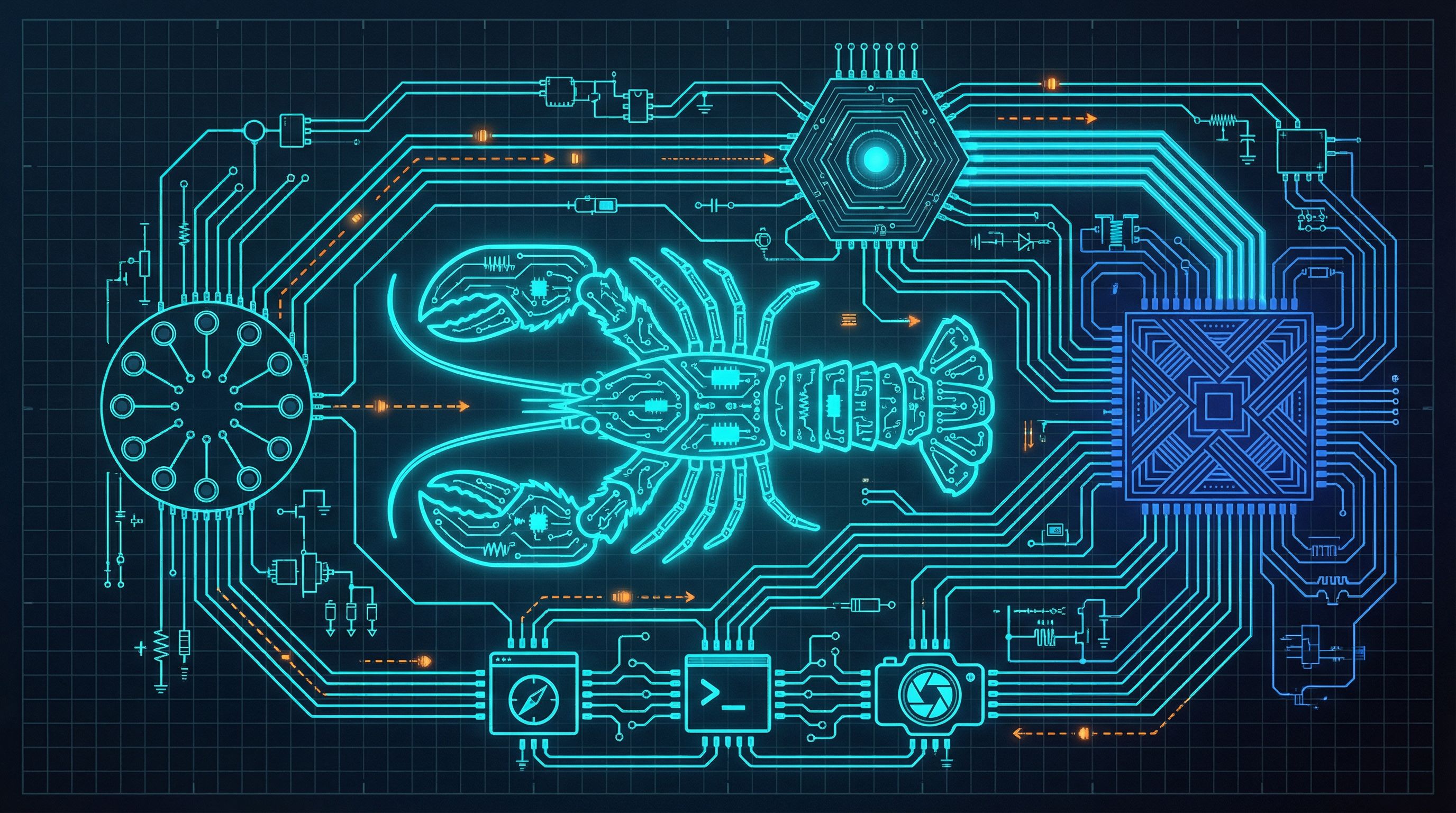
At its core, Clawdbot is a Gateway server that connects Claude (or other LLMs) to your messaging platforms. WhatsApp, Telegram, Slack, Discord, Signal, iMessage: twelve platforms in total, unified under a single conversation context.
The architecture looks like this:
[Messaging Platforms] → [Gateway (WebSocket)] → [Pi Agent Runtime] → [Claude API]
                              ↓
                        [Sessions + Memory]
                              ↓
                    [Tools: Browser, Shell, Nodes]
You self-host the Gateway. It maintains persistent sessions. It can execute shell commands, automate browsers, and, if you're on macOS, access your camera, screen, and system tools through paired "Nodes."
The agent loop itself is standard Claude tool-use: intake, context assembly, model inference, tool execution, streaming replies, persistence.
Nothing novel here. This is the same pattern as Claude Code, Cursor, Aider, and every other agentic coding tool. The differentiation is upstream and downstream, what triggers the loop and where the output goes.
The SOUL.md Architecture
Here's something genuinely novel that most coverage misses: Clawdbot introduces version-controlled AI personality.
The workspace structure looks like this:
~/clawd/
├── SOUL.md           # Who the AI chooses to be
├── AGENTS.md         # Agent configuration
├── TOOLS.md          # Available tools
├── memory.md         # Durable facts and preferences
├── memory/
│   └── YYYY-MM-DD.md # Daily narrative logs
└── bank/
    ├── world.md      # Objective facts
    ├── experience.md # First-person experiences
    └── Peter.md      # Entity-specific memory
The SOUL.md file defines personality, not capabilities, but values, boundaries, and relationship style. It's the difference between "what can this AI do" and "who is this AI."
The clever part: workspaces can be Git repositories.
If your agent learns something incorrectly, develops a wrong assumption about your preferences, misremembers a fact, adopts an unwanted behavior, you can git revert. You can diff personality changes over time. You can branch experimental personalities and merge them back.
This is version-controlled identity. I haven't seen this pattern elsewhere.
The memory system uses Markdown as the canonical source of truth, with a derived index for search. It's offline-first by design: your agent's memories are files you can read, edit, and back up with standard tools.
The Technical Stack
Let's look under the hood.
Core Dependencies
"@mariozechner/pi-agent-core": "0.49.3"  // Closed-source agent runtime
"@agentclientprotocol/sdk": "0.13.1"     // ACP support (Zed's protocol)
"@whiskeysockets/baileys": "7.0.0"        // WhatsApp (unofficial)
"grammy": "^1.39.3"                        // Telegram
"sharp": // Image processing
The interesting bit: Pi Agent Core is closed-source. You can't inspect the actual agent runtime. The public repo is orchestration and integrations around a proprietary core.
Protocol Support
| Protocol | Purpose | Clawdbot Support |
|---|---|---|
| ACP (Agent Client Protocol) | Editor to Agent | Yes (v0.13.1) |
| A2A (Google Agent-to-Agent) | Agent to Agent | No |
| MCP (Model Context Protocol) | Agent to Tools | No |
ACP means Clawdbot can act as a backend for Zed, Neovim, and JetBrains IDEs. But no MCP support is notable: it's using a proprietary skills system instead of Anthropic's standard.
The Protocol Landscape
Clawdbot's choice to use ACP instead of MCP deserves explanation. These aren't competing standards, they solve different problems.
MCP (Model Context Protocol) from Anthropic standardizes how models access tools and resources. It's stateless, synchronous, and focused on tool invocation.
ACP (Agent Client Protocol) from Zed Industries standardizes communication between code editors and coding agents. It's designed for streaming, persistent sessions, and IDE integration.
Why Clawdbot chose ACP:
| Capability | MCP | ACP |
|---|---|---|
| Streaming | Complete messages only | Delta streams (token-by-token) |
| Memory | Single server scope | Cross-session persistence |
| Long-running tasks | Not designed for | Native pause/resume |
| Human-in-the-loop | Not native | Built-in |
The gap that matters: MCP assumes request-response patterns. ACP assumes ongoing relationships. Clawdbot needs to maintain context across days of conversation, pause tasks waiting for human input, and stream partial results to messaging apps.
Notably, ACP recently merged with Google's A2A protocol under Linux Foundation governance. The ecosystem is consolidating toward MCP for tool access, ACP for agent-editor integration, and A2A for agent-to-agent collaboration.
What's Actually Innovative
After a week of analysis, I identified four genuinely clever design decisions.
1. The "AI Comes to You" Inversion
This is the core insight. We've spent years going to websites to talk to AI. Clawdbot inverts this.
"The assistant should come to you."
It's proactive. Morning briefings. Reminders. Alerts when something you care about happens. Most chatbots wait for input. This one initiates.
This isn't technically complex, it's a cron job plus push notifications, but it's a product paradigm shift that most agent frameworks ignore.
2. Self-Improving Skills System
Here's where it gets interesting:
"It realised it needed an API key... opened my browser... opened Google Cloud Console... configured OAuth and provisioned a new token."
The agent can write and install its own extensions. ClawdHub is a skills marketplace where agents can search and pull new capabilities automatically during execution. Skills come in three flavors: bundled (built-in), managed (from ClawdHub), and workspace (local custom).
In my tests, I found the skills system scales well—40+ skills installed including google-workspace, meeting-notes, perplexity-search, and github-sync. This enabled automated morning briefs, proactive alerts, and building new skills by conversation rather than code.
The skills system is designed for runtime modification by the agent itself. You're not just using a tool, you're growing one.
3. Hybrid Node Architecture
Gateway runs centrally (your server). Nodes run on devices (your Mac, iPhone, iPad).
Gateway (server)          Node (device)
├── Messaging             ├── Camera
├── Session management    ├── Screen recording
├── Agent runtime         ├── Microphone
└── Central tools         └── Local shell
"Run this on my Mac" works from anywhere. The device tools execute locally; the intelligence lives on the Gateway. It's a clean separation that enables remote device control without exposing your home network.
4. Cross-Session Coordination
Tools like sessions_list, sessions_history, and sessions_send let the agent coordinate across different conversations without you switching contexts.
Your work Slack, personal Telegram, and family WhatsApp group can share context when needed. The agent becomes a meta-layer across your communication graph.
Multi-Agent Orchestration
The most technically interesting capability isn't in the official docs: it's in how power users are deploying Clawdbot.
People are running multi-agent setups across machines: two agents on a GCP VM, one on a Raspberry Pi at home, with a node on a Mac. The interesting part is that agents can SSH into each other's machines and debug each other when things break.
Is it possible for one agent to diagnose and restart another? Yes—an agent can SSH into another's machine, identify issues like bloated context, fix and restart the affected agent, then ping back when done. No manual handoffs required.
Communication happens via Telegram: DMs with each agent, plus topic-based groups for different work contexts.
The pattern extends to code review. People are wiring Clawdbot to orchestrate Codex and Claude, have them debate reviews autonomously, and notify when done. A whole feature deployed while you're out on a walk—that's the promise, at least.
This isn't built-in functionality: it's emergent from giving agents shell access and the ability to communicate across sessions.
The Self-Improvement Pattern
What's genuinely novel is agents improving their own infrastructure:
"Just had Clawdbot set up Ollama with a local model. Now it handles website summaries locally instead of burning API credits. Blown away that an AI just installed another AI to save me money."
"Clawdbot is controlling LMStudio remotely from Telegram, downloading Qwen, which it will then use to power some of my tasks."
This is AI installing AI. Recursive self-improvement at the infrastructure level.
The most extreme example:
"I gave Clawdbot access to RTL-SDR radio hardware and asked it to decode Fulton County Fire & Tactical radio. 30 minutes later, it was listening to trunked emergency comms in real-time. I didn't teach it SDR. I didn't give it a manual. I handed it hardware and a goal. It researched, configured, and executed."
This is what agentic AI actually looks like. Not chatbots with tools, systems that acquire capabilities they weren't programmed with.
What's Just Good Engineering
Let's be honest about what isn't novel: multi-platform abstraction (integration work with Baileys for WhatsApp, grammy for Telegram, standard SDKs for the rest), WebSocket Gateway (standard chat server architecture), context compaction (every agent framework does this now), model fallback (common pattern), and skills/plugin system (plugin architectures exist everywhere).
The quality of execution is high. The engineering is solid. But these are solved problems being solved again.
The Mac Mini Question
Why is everyone buying Mac minis for this?
macOS gets exclusive features Linux doesn't have:
| Feature | macOS | Linux/Pi |
|---|---|---|
| Camera tools | camera.snap, camera.clip | No |
| Screen recording | screen.record | No |
| Voice wake | Native | Limited |
| Canvas/A2UI | Full support | No |
| iMessage | Yes | No |
| Menu bar app | Yes | No |
If you're on Linux or Raspberry Pi, you get the Gateway and messaging channels, but not the device integration. You lose maybe 30% of the experience.
Is that 30% worth a $599+ Mac mini? For most use cases, probably not. The messaging + automation + shell access works fine without it.
Enterprise Readiness: Not There Yet
Let me be direct: Clawdbot is not enterprise-ready.
| Requirement | Status |
|---|---|
| SOC2 compliance | No |
| HIPAA | No |
| SSO/SAML | No |
| Multi-tenant | No |
| SLA | Community support only |
| Audit logging | Basic transcripts |
It's MIT-licensed, self-hosted, and designed for tinkerers. That's fine, it's honest about what it is.
But if your compliance team needs sign-off, look elsewhere. Enterprise deployments need custom solutions.
The Cost Reality
Let's make the API cost concern concrete.
Federico Viticci burned through 180 million Anthropic tokens in one week. At current Claude Sonnet 4.5 rates ($3/million input, $15/million output), that's roughly $900-1,500 per week depending on input/output ratio. For heavy users, Clawdbot is a $4,000-6,000/month expense before hardware.
Power users fight this with multi-model routing: Batch API (50% discount for async processing), prompt caching (cache reads at 0.1x base price), local model offloading (route cheap queries to Ollama/LMStudio), and Codex routing (use cheaper agents for coding tasks).
The self-improving capability helps: agents can autonomously set up local models to reduce API spend.
The Building Blocks Perspective
Here's the uncomfortable truth for anyone building in this space: every component of Clawdbot exists independently.
| Component | Available Solutions |
|---|---|
| LLM | Claude, GPT-4, Gemini, Llama |
| STT | Deepgram, AssemblyAI, Whisper |
| TTS | Cartesia, ElevenLabs, PlayHT |
| Voice orchestration | LiveKit, Pipecat |
| Agent frameworks | LangChain, LangGraph, CrewAI |
| Messaging | Baileys, grammy, Slack SDK |
| Memory/RAG | Pinecone, pgvector, Chroma |
I run a voice AI assistant on my Raspberry Pi using LiveKit + Claude + Deepgram + Cartesia. It achieves "Siri that actually works" for voice interactions. The building blocks are mature.
Clawdbot's contribution is orchestration and product polish, not new primitives. It's the iPhone of personal AI agents: it didn't invent touchscreens, but it assembled them brilliantly.
The question for builders: do you orchestrate existing blocks, or wait for the ecosystem to commoditize what Clawdbot assembled?
My Verdict
Clawdbot is impressive product engineering, not breakthrough technology.
The value is real: text your AI from any platform, persistent memory across sessions, proactive outreach, and self-hosted data control.
The hype is overblown: core tech is standard Claude tool-use, Mac-first development leaves Linux users behind, enterprise readiness is years away, and closed-source Pi Agent Core limits transparency.
For AI engineers: Study the product decisions, not the architecture. The "AI comes to you" inversion and self-improving skills system are worth understanding.
For product managers: This is what happens when someone prioritizes integration quality over novel algorithms. Users don't care about your agent framework, they care about whether it works in their WhatsApp.
For builders: The building blocks are commoditized. The orchestration layer is where value accrues. But remember: Apple and Google can commoditize that layer too.
Should You Use It?
Yes, if: You want unified AI across messaging platforms. You're comfortable with self-hosting. You're on macOS (or okay with reduced features). You want a polished out-of-box experience.
No, if: You need enterprise compliance. You want full transparency (closed-source core). You prefer building with standard protocols (MCP). You're cost-sensitive about API usage.
For Raspberry Pi/Linux users: It works, but you're getting 70% of the experience. Consider n8n + Jarvis template for more control, or wait for the ecosystem to mature.