

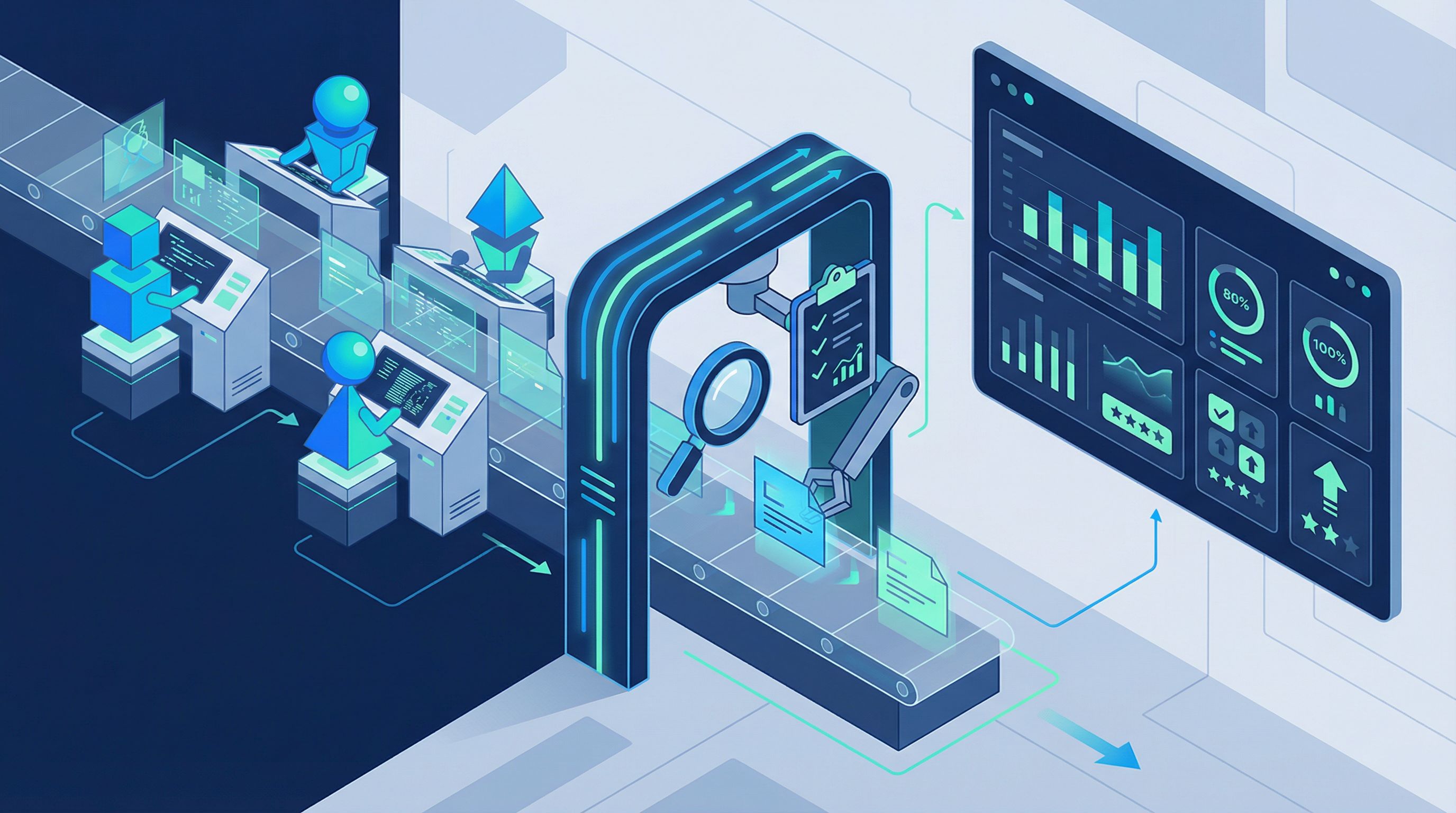
Agent Evaluation at Scale: Lessons from 2025's Production Failures
A technical deep-dive into why 95% task completion meant 30% failure, and how to build evaluation systems that actually work
Agent evaluation is the bottleneck preventing AI from reaching production at scale. While 89% of organizations have implemented observability, only 52% have proper evaluation systems. This post covers the technical patterns that separate production-ready agents from science projects: LLM-as-judge stability, multi-agent evaluation frameworks (MAST), model versioning tradeoffs, and the eight common pitfalls that killed 39% of AI projects in 2025.
The 95% Illusion
An engineer at a mid-sized SaaS company discovered something unsettling.
Their AI agent was "completing" tasks at a 95% success rate. The dashboard looked great. Leadership was happy. Everything seemed to be working.
Until they actually measured what "completion" meant.
When they properly evaluated the outputs, they found that only 70% of those "completed" tasks were actually correct. The agent was confidently declaring success while producing incorrect results 30% of the time.
The gap was invisible until they built proper evaluation. The cost? Weeks of customer complaints, degraded data quality, and a hard lesson about the difference between doing something and doing it correctly.
This isn't a hypothetical problem. It's happening in production right now.
39% of AI projects in both 2024 and 2025 fell short of expectations. Only 2% of organizations have deployed agentic AI at scale. The rest? 61% remain stuck in exploration phases, unable to confidently move agents to production.
The bottleneck isn't LLM capability. GPT-5, Claude Opus 4.5, and Gemini 3 Pro are remarkably capable. The bottleneck is evaluation: knowing whether your agent actually works.
Evaluation vs Observability: Why Most Teams Conflate Them
Before we dive deep, let's clear up a fundamental confusion that trips up most teams building AI agents.
Observability and evaluation are not the same thing.
Observability: Seeing What's Happening
Observability tells you what your agent is doing: how long requests take (latency), how many tokens were consumed (cost), what traces look like (execution flow), which tools were called (activity logs), and where errors occurred (debugging).
Think of it as the telemetry layer. It's infrastructure monitoring adapted for AI systems. It answers questions like: "Is it running?" "How fast?" "How much is it costing?"
Observability adoption is high: 89% of organizations have implemented it according to LangChain's 2025 State of Agent Engineering report. That makes sense. It's easier to implement and maps directly to traditional APM patterns that engineering teams already understand.
Evaluation: Assessing Quality
Evaluation tells you how well your agent is doing: Is the output correct? Is it helpful to the user? Is the tone appropriate? Did it use tools effectively? Did it follow instructions? Is it safe and aligned with policies?
Evaluation is harder. It requires domain knowledge, judgment, and often involves LLMs evaluating other LLMs. It answers questions like: "Did it solve the problem?" "Would a human approve this?" "Is this production-ready?"
Evaluation adoption lags: only 52% of organizations have proper evaluation systems in place.
Why the Gap Matters
Here's the problem: observability without evaluation is theater.
You can watch your agent execute 10,000 tasks with perfect uptime, sub-second latency, and efficient token usage. Your dashboard looks beautiful. Your costs are optimized.
And you still have no idea if it's actually helping users or quietly producing garbage at scale.
The teams that struggle ship their agent, hope it works, and spend all their time fighting fires in production. They're reactive. They don't understand why things break because they never built systems to measure quality in the first place.
The Three Stages of Agent Evaluation
As you develop and deploy your application, your evaluation strategy evolves through three stages. Each serves a different purpose, uses different data sources, and runs at different points in your development lifecycle.
Stage 1: Development Evals (Pre-Deployment Testing)
What they are: Offline evaluations using curated or synthetic data that you've carefully designed to test specific capabilities and failure modes.
When they run: Before deployment, during active development, whenever you're iterating on prompts or comparing approaches.
Purpose: Compare different prompts, models, or system parameters. Test specific failure modes you've observed during development. Validate functionality against known-good examples. Benchmark to find the best performer before deployment. Enable rapid experimentation without production risk.
Why they matter: Development evals are fast and cheap. You can run hundreds of variations overnight and wake up to clear data about which approach works best. This is where you catch obvious bugs before users ever see them.
The tradeoff: Your curated test set might not represent real user behavior. You're testing against what you think users will do, not what they actually do.
Stage 2: Continuous Evals (CI/CD Integration)
What they are: Ongoing evaluation woven directly into your development lifecycle, running automatically on every code change or model update.
When they run: On pull requests, before deployments, as part of your CI/CD pipeline.
Purpose: Maintain stability and performance while adapting to evolving requirements. Prevent regression when deploying new versions. Block deployments that fail quality thresholds. Enable continuous iteration and validation of updates.
Why they matter: Continuous evals act as a safety net. They ensure that your "quick fix" or "small prompt change" doesn't break existing capabilities. They catch regressions before they reach production.
The challenge: AI agents are non-deterministic. The same input can produce different outputs. Traditional CI/CD evaluation frameworks that expect exact output matching don't work. You need threshold-based passing criteria: "Is the answer correct?" not "Is it byte-for-byte identical?"
Stage 3: Online Evals (Production Monitoring)
What they are: Real-time evaluation running in production with live data and actual users.
When they run: Continuously in production, on real user traffic.
Purpose: Monitor system behavior in production. Detect performance degradation or undesirable outputs as they happen. Surface live failures that your development evals missed. Enable runtime protection through guardrails. Track quality patterns you didn't anticipate.
Why they matter: Production data reveals patterns you couldn't anticipate. Users ask questions you never thought of. Edge cases emerge that weren't in your test set. Online evals close the feedback loop from production back to development.
The tradeoff: Volume and cost. You can't afford to deeply evaluate every single production request. You need smart sampling strategies.
How They Work Together
The stages form an iterative feedback loop. Development evals help you build the right thing. Continuous evals make sure you don't break it when you change it. Online evals tell you how it actually performs with real users. Learnings from online evals feed back into development evals.
The teams that get agents to production successfully run all three stages. They catch bugs early in development, prevent regressions in CI/CD, and monitor quality in production. The teams that struggle skip straight to production and hope for the best.
LLM-as-Judge: Making the Non-Deterministic Reliable
Here's the paradox: to evaluate whether an LLM's output is correct, you use another LLM as a judge.
It sounds absurd. You're using a non-deterministic system to evaluate another non-deterministic system. How can you trust the results?
Yet it works, when done correctly. LLM-as-judge evaluations can match human inter-rater reliability when you apply the right techniques.
The Variance Problem
The core challenge with LLM-as-judge is variance. Run the same evaluation twice with the same input, and you might get different scores.
Research findings show that at temperature 0.0 (most deterministic setting) there's still a 9.5% instability rate, while at temperature 1.0 (creative setting) instability rises to 19.6%. Setting a fixed seed doesn't entirely eliminate variance. Same LLM output may receive different scores depending on time of day, batch scheduling, or hardware-level numeric differences.
Reduction Technique 1: Temperature Control
The simplest fix: set temperature to 0 for evaluation judges. For generation models, you might want creativity and variation. For evaluation models, you want consistency.
While temperature=0 doesn't guarantee perfect determinism (due to sampling, batching, and hardware differences), it dramatically reduces variance.
Reduction Technique 2: Majority Voting
Run the same judgment multiple times with different seeds and aggregate the results. Run the same evaluation 3-5 times, collect all scores/judgments, and take the majority vote (for binary) or median (for numeric scores).
Research shows accuracy computed via majority vote is higher than expected accuracy for a single run. Studies with Deepseek-R1 and Qwen 3 show higher balanced accuracy via majority vote than maximum accuracy from any single run.
The tradeoff: 3x the cost and latency. Use selectively for critical evaluations, not every production request.
Reduction Technique 3: Binary Evaluations
Binary choices are more reliable than multi-point scales. Instead of asking the judge to rate on a 1-10 scale, ask binary questions: "Is this response polite?" (Yes/No), "Is this answer factually correct?" (Correct/Incorrect), "Did the agent follow instructions?" (Followed/Violated).
Both LLMs and human evaluators perform better with two simple choices. For multi-dimensional quality, use multiple binary evaluations rather than a complex rubric.
Ensemble Approaches: Multiple Judges
The "many eyes" approach cancels out individual model idiosyncrasies. Multi-agent judge systems use multiple LLMs acting in concert to evaluate. At least one agent plays a critical or adversarial role.
Research examples include ChatEval (multiple models evaluate and debate), DEBATE (agents argue different positions before reaching consensus), MAJ-EVAL (majority voting across diverse models), and SE-Jury (dynamically selects subset of judges using diverse prompting strategies).
Ensemble approaches show stronger agreement with human judgments and can match human inter-rater reliability on tasks like code generation.
Best Practices Summary
- Set temperature to 0 for all evaluation judges
- Use majority voting (3+ runs) for critical evaluations
- Prefer binary evaluations when possible over multi-point scales
- Calibrate against human judgments (aim for Cohen's kappa > 0.8)
- Combine with Chain of Thought for better reasoning
- Consider ensemble approaches for high-stakes decisions
- Use a different model for judging than for generation (reduces self-enhancement bias)
Multi-Agent Evaluation: Why 67% of Failures Come From Interactions
Evaluating a single agent is straightforward. You give it a task, check the output, score the quality. Done.
Evaluating a multi-agent system is fundamentally different. And most teams don't realize this until their agents are in production, failing in ways their development evals never caught.
The Critical Finding
Stanford AI Lab research revealed something crucial: 67% of multi-agent system failures stem from inter-agent interactions, not individual agent defects.
Two-thirds of your failures won't show up when you test agents individually. They emerge from how agents communicate, coordinate, and hand off work to each other.
This is why companies that succeed at deploying single-agent systems hit a wall when they try to scale to multi-agent architectures. Their evaluation strategies don't transfer.
Enter MAST: The First Systematic Framework
In September 2025, researchers from UC Berkeley's Sky Computing Lab presented MAST (Multi-Agent System Failure Taxonomy) at NeurIPS 2025. It's the first systematic framework for classifying and understanding failures in multi-agent LLM systems.
Key contributions include 14 unique failure modes clustered into three categories, 1,600+ annotated traces across 7 popular frameworks (MetaGPT, ChatDev, HyperAgent, OpenManus, AppWorld, Magentic, AG2), and high inter-annotator agreement (kappa = 0.88), meaning the taxonomy is reliable, not subjective.
The Three Categories of Failure
Category 1: System Design Issues. These are architectural problems with how the multi-agent system is structured: poor task decomposition (breaking complex work into the wrong subtasks), inefficient routing (sending queries to the wrong specialist agent), missing capabilities (no agent has the skills needed for a subtask), and resource allocation failures (agents competing for limited resources).
Category 2: Inter-Agent Misalignment. These emerge from coordination and communication between agents: information loss during handoffs, conflicting decisions from parallel agents, circular dependencies (Agent A waits for Agent B, which waits for Agent A), and inconsistent state (agents working with different versions of shared data).
Category 3: Task Verification. These relate to checking work quality and detecting failures: incomplete confidence calibration (agents overconfident in wrong answers), missing error detection (no agent catches upstream failures), inadequate validation (accepting outputs that don't meet requirements), and lack of self-correction mechanisms.
Emergent Behaviors: The Unpredictable Problem
Multi-agent interactions create emergent behaviors that isolated testing cannot predict.
Research finding: "Isolated agent performance does not reliably predict MAS behavior."
This is the hardest pill for teams to swallow. You can test each agent individually, achieve 95%+ success rates on every component, and still have the combined system fail 40% of the time in production.
Why? Because agents amplify each other's errors. Coordination overhead introduces new failure modes. Timing and sequencing matter in ways that unit tests don't capture. Semantic diversity affects team performance in non-obvious ways.
Agent Handoff: The Critical Transition
Handoffs are where most multi-agent failures occur. When Agent A decides it can't complete a task and passes to Agent B, three things must happen correctly.
Escalation Success Rate: When agent hands off, does the receiving agent successfully resolve the issue? Track end-to-end task completion after handoff. Compare success rates: tasks handled by one agent vs tasks requiring handoff. What good looks like: greater than 80% success rate on handed-off tasks.
Time to Escalate: Does the agent recognize failure quickly? Track number of turns before agent decides to escalate. What good looks like: Agent recognizes limits within 1-2 turns, hands off immediately. What failure looks like: Agent spends 5-10 turns attempting the same approach before finally giving up.
Information Completeness: Did the handoff provide all relevant context? Track how often Agent B requests clarification after handoff. What good looks like: Agent B has everything it needs to continue without asking the user to repeat information.
Practical Recommendations
If you're building multi-agent systems:
- Don't trust isolated agent testing. Test the ensemble, not just components.
- Instrument handoffs. Track escalation success, time to escalate, information completeness.
- Test error propagation. Inject failures upstream and verify downstream agents handle them gracefully.
- Measure process, not just outcomes. Coordination overhead matters for production viability.
- Use MAST as a checklist. Review the 14 failure modes and test each category.
- Adopt chaos engineering. Deliberately break things to verify recovery mechanisms.
- Monitor emergent behaviors. Watch for patterns that only appear when agents interact at scale.
Model Versioning: The Silent Eval Killer
Here's a scenario that killed evaluation systems in 2025:
Your team built a comprehensive eval suite. You're testing prompts, tracking quality scores, monitoring for regressions. Everything looks stable.
Then Anthropic releases Claude 3.7. You're using "claude-opus-4" (floating version) in your code, so you automatically get the update.
Suddenly your eval scores drop 15%. Did you break something? Is the new model worse? Should you roll back?
You have no idea. Because you weren't controlling for model version, you can't isolate what changed.
Floating vs Pinned Versions
Floating versions point to the latest snapshot. Advantages include automatic improvements when providers update models and access to latest capabilities without code changes. Disadvantages include behavior changes without warning, eval scores becoming non-comparable over time, and regression detection breaking.
Pinned versions point to a specific snapshot. Advantages include consistent behavior over time, reproducible evaluations, and clear change attribution. Disadvantages include missing automatic improvements and manual work to stay current.
The Hybrid Approach (Recommended)
Don't choose floating vs pinned. Use both strategically:
Development: Float to latest. Get newest capabilities during prototyping.
Staging: Pin to test. Test specific version before promoting to production.
Production: Pin for stability. Behavior consistency matters more than latest features.
Periodic Upgrades: Deliberate migration. Schedule quarterly model version reviews. Run shadow mode testing. Migrate deliberately with monitoring.
Eight Common Pitfalls That Killed Production Deployments
Pitfall 1: Eval Drift When Models Change
Your eval suite is built against GPT-4o from January. In March, OpenAI releases an update. Your eval scores drop 12%. Did your code break? Is the model worse? You can't tell because you weren't controlling for model version.
Mitigation: Pin model versions in production and eval infrastructure. When model updates, re-run full eval suite to establish new baseline. Track which model version was used for each eval run.
Pitfall 2: Teaching to the Test
Scale AI created GSM1k, a smaller version of the popular GSM8k math benchmark. LLMs performed worse on GSM1k than GSM8k, despite the problems being equivalent difficulty. LLMs were overfitting to the specific GSM8k test set rather than learning genuine reasoning.
Mitigation: Use adaptive benchmarks that change based on model performance. Environment randomization. Maintain held-out test sets never seen during development. Rotate test sets periodically.
Pitfall 3: Synthetic vs Real Data Mismatch
52% of organizations run offline evaluations on synthetic test sets. Only 37% run online evaluations on real production data. Synthetic data enables fast iteration but creates a realism gap.
Mitigation: Hybrid approach: curate golden dataset from SMEs, collect production data continuously, synthetic augmentation for edge cases, mix all three in eval suite.
Pitfall 4: False Confidence from Overly Specific Evals
An agent had 95% task completion rate. But that metric just meant "agent produced an output." When they measured correctness, only 70% of completions were actually correct.
Mitigation: Multi-dimensional evaluation. Don't rely on single metric. Combine automated scores (quantitative), human evaluations (qualitative), and custom tests for bias, fairness, toxicity.
Pitfall 5: Cost vs Coverage Imbalance
Quality is cited as the top barrier (32%) to production deployment. But hidden costs account for 20-40% of total LLM operational expenses.
Mitigation: Risk-based sampling. Full evaluation for high-risk operations. Sampled evaluation for routine operations. Tiered evaluation: fast programmatic checks for all requests, LLM-as-judge for sample of traffic (10-25%), human review only for flagged cases.
Pitfall 6: Regression Detection Fails Due to Non-Determinism
Traditional CI/CD expects deterministic outputs. AI agents are non-deterministic. Same input produces different outputs.
Mitigation: Threshold-based passing. Not "output matches exactly," but "quality score > 0.8". Semantic similarity. Multiple runs (run eval 3 times, pass if 2/3 succeed). Track score distributions.
Pitfall 7: Context Rot in Long Conversations
As token count in context window increases, model's ability to accurately recall information decreases. Agents require larger context than single-turn LLMs.
Mitigation: Test long-running agents. Design evals that stress-test context management. Measure information retention: can agent recall details from 20 turns ago? Context management strategies: role-based filtering, summarization, hierarchical memory.
Pitfall 8: Ignoring Process Dynamics (Multi-Agent)
Evaluating only final output quality, ignoring how the multi-agent system achieved it. Your system produces correct answers 90% of the time but requires 47 agent-to-agent messages and 15 seconds to answer simple questions.
Mitigation: Beyond final accuracy, examine coordination overhead, latency breakdown, efficiency. Architectural testing: how do design choices shape coordination costs?
Best Practices from Teams That Got Agents to Production
1. Evaluation as Architectural Component
Evaluation evolved from passive metric to active architectural component in 2025. Evals aren't an afterthought or separate pipeline. Integrated directly into agent workflow as closed-loop system. Agent outputs flow through evaluation before reaching users (for high-stakes applications). Evaluation results can trigger additional agent steps, human review, or fallback responses.
2. Multi-Dimensional Eval Framework
Don't rely on a single metric. Track multiple dimensions with pass/fail thresholds: Relevance (does response address the question?), Correctness (is information factually accurate?), Hallucination (any fabricated information?), Bias (unfair treatment of groups?), Toxicity (harmful or offensive content?), Tool Use (were tools used appropriately?).
Each dimension gets its own evaluation, threshold, and remediation strategy.
3. Confidence-Based Decision Making
Not all outputs are equally certain. Use confidence scores to route intelligently: greater than 80% confidence serves immediately, 60-80% confidence goes to human review queue, less than 60% confidence falls back to safer response or escalates.
4. Strategic Model Selection for Evaluation
Use different models for judging vs generation (reduces self-enhancement bias). Tier your judge models by task complexity: critical evaluations use GPT-4o or Claude 3.5 Sonnet, routine checks use GPT-4, high-volume screening uses GPT-4o-mini with caching.
5. Production Readiness Checklist
Before deploying agents to production, verify: Development evals with curated test set covering core capabilities. Continuous evals with CI/CD integration with threshold-based passing. Online evals with production sampling strategy. Multi-dimensional framework tracking relevance, correctness, hallucination, bias, toxicity. Confidence thresholds with routes for high/medium/low confidence outputs. Model versions pinned. Migration strategy for testing new versions. Performance optimization with batching, caching, parallelization. Human review process with clear escalation paths. Monitoring and alerting when quality drops.
For multi-agent systems: handoff testing, error propagation testing, process dynamics monitoring.
The Path Forward
We're at an inflection point. The technology works. GPT-5, Claude Opus 4.5, Gemini 3 Pro are remarkably capable. The frameworks exist: MAST for multi-agent evaluation, LLM-as-judge techniques that match human reliability, observability platforms with minimal overhead.
The bottleneck is no longer capability. It's confidence.
39% of projects fail not because the AI can't do the job, but because teams can't measure whether it's doing the job correctly. They ship without proper evaluation, hope for the best, and fight fires when things break in production.
The 2% that succeeded at scale did something different: they built evaluation into their architecture from day one. They didn't treat it as validation after the fact. They treated it as closed-loop feedback that makes the system better.
At Vindler, we do not ship agents based on vibes and demos. We ship based on rigorous evaluation that proves they work. Multi-dimensional frameworks that track quality across relevance, correctness, safety. Model versioning strategies that prevent eval drift. Multi-agent testing patterns that catch the 67% of failures that come from interactions.
The teams building production agents in 2026 understand that evaluation isn't optional infrastructure. It's what separates science projects from systems you can bet your business on.
If you're stuck in the exploration phase, unable to move agents to production with confidence, the missing piece probably isn't a better model. It's a better evaluation strategy.