

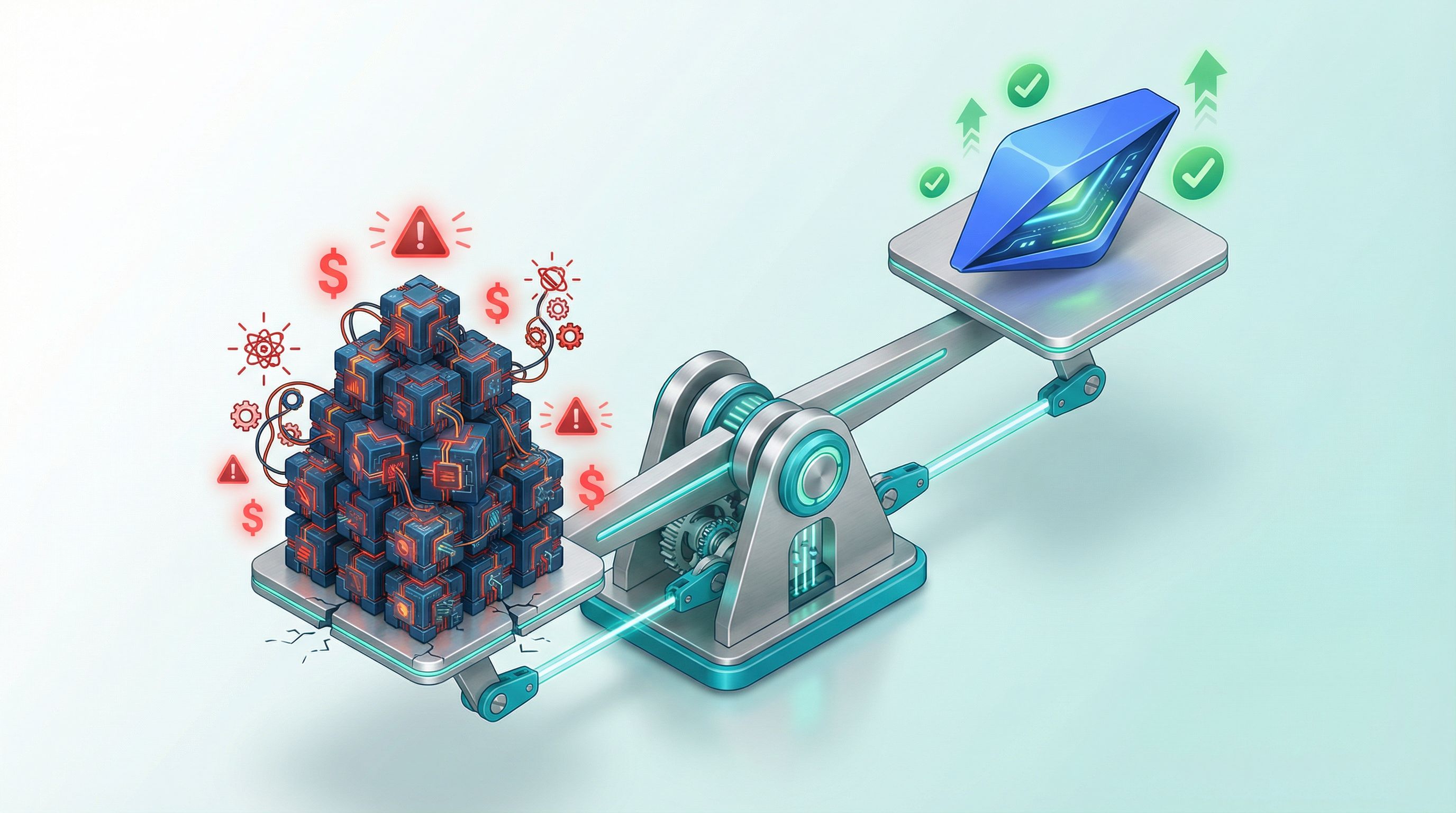
Multi-Agent Systems: When the Hype Meets Reality
The AI engineering community is buzzing about multi-agent systems, swarms, and complex agent graphs. The excitement is justified: these patterns demonstrate remarkable capabilities in tackling sophisticated problems like autonomous coding, complex research tasks, and adversarial scenarios. But if you're leading AI adoption at your company, there's a critical question you need to answer before jumping on the multi-agent bandwagon: Do you actually need it?
The truth is, a significant portion of real-world business problems can be effectively solved with well-architected single-agent systems. Before you commit to the complexity of multi-agent architectures, let's examine the tradeoffs that rarely make it into the hype cycle.
Why Multi-Agent Systems Exist
Multi-agent architectures shine in specific scenarios.
Complex, decomposable tasks where different specialized agents handle distinct sub-problems. LangGraph-based coding assistants exemplify this: a planner agent designs the approach, a coder agent implements, a reviewer agent validates, and a debugger agent fixes issues. Each agent has a focused responsibility, and the orchestration between them creates emergent capabilities beyond what a single agent could achieve.
Systems with inherent trust boundaries where agents represent different stakeholders with potentially conflicting interests. Think buyer and seller agents negotiating terms, or compliance agents validating decisions made by operational agents. The multi-agent structure mirrors the real-world dynamics of these interactions.
Parallelizable workloads where multiple agents can work simultaneously on independent subtasks, then synthesize results. Research tasks that require gathering information from multiple sources, or data processing pipelines that can split work across specialized processors.
These are legitimate use cases. The problem isn't multi-agent systems themselves: it's applying them to problems that don't require their complexity.
The Single-Agent Alternative
Most business AI applications fall into categories where single agents excel: customer support chatbots that handle inquiries, route issues, and provide information; document processing assistants that extract, classify, and summarize information; personalized recommendation engines that analyze user preferences and suggest products; business process automation that handles routine workflows and decision-making; and internal knowledge assistants that help employees find information across company resources.
These applications benefit from simplicity. A well-designed single agent with proper prompt engineering, retrieval-augmented generation (RAG), and function calling can handle complex workflows without the overhead of agent orchestration.
The Hidden Costs of Multi-Agent Architectures
Context Sharing and State Management
In single-agent systems, context is straightforward: the conversation history, retrieved documents, and system state exist in one place. The agent has a unified view of the problem.
Multi-agent systems fragment this context. How do you share information between agents? Do you pass full conversation history to each agent (token explosion)? Maintain a shared memory store (consistency and race condition challenges)? Use message passing with serialized context (information loss and versioning issues)?
Each approach introduces complexity. Agent A's context might be stale by the time Agent B acts on it. Shared state requires locking mechanisms or eventual consistency patterns. You're now solving distributed systems problems on top of your AI problem.
Real-world impact: A client came to us with a multi-agent customer service system where agents would give contradictory answers because they had different views of the customer's issue history. Converting to a single agent with structured state management eliminated the inconsistencies and reduced their token costs by 60%.
Token Consumption
Multi-agent systems are token-intensive. Every agent interaction involves context loading for the new agent, orchestrator overhead deciding which agent to invoke, inter-agent communication messages, and potentially redundant processing of shared information.
Consider a three-agent system handling a customer query. First, a router agent analyzes the query (1,000 tokens). Then a specialist agent processes the request (3,000 tokens). A response validator reviews the output (2,000 tokens). The orchestrator manages handoffs (500 tokens per transition). Total: approximately 7,000 tokens for what might be a 2,000-token single-agent interaction.
At scale, this matters. If you're processing 100,000 queries per month, you're looking at 500M tokens vs 200M tokens: a difference of thousands of dollars monthly, before considering the infrastructure to manage agent orchestration.
Testing and Debugging Complexity
Single agents have linear execution paths. You can write unit tests for specific prompt variations, replay conversations to reproduce issues, track exactly what context led to specific outputs, and A/B test prompt changes with clear attribution.
Multi-agent systems introduce non-determinism at the architecture level. Agent routing decisions create branching execution paths. Timing issues between agents can cause flaky tests. Bugs might emerge from agent interaction patterns, not individual agent logic. Reproducing issues requires recreating the entire agent choreography.
Debugging scenario: An e-commerce client's multi-agent recommendation system occasionally suggested out-of-stock items. The bug only appeared when the inventory-check agent had high latency, causing the recommender agent to work with stale data. This race condition took three weeks to identify and fix. A single agent with synchronous inventory checking would have made this class of bug impossible.
Team Collaboration and Development Velocity
Single-agent development is familiar to most engineers: one prompt to optimize, clear input/output contracts, standard software engineering practices apply, and easy to onboard new team members.
Multi-agent systems require coordination protocols between teams working on different agents, integration testing infrastructure, versioning strategies for agent APIs, shared understanding of orchestration logic, and specialized knowledge of agent frameworks (LangGraph, CrewAI, AutoGen).
Your team velocity drops as coordination overhead increases. Simple changes might require updates to multiple agents and their interaction patterns. The "two-pizza team" rule becomes harder to maintain.
Security and Permission Boundaries
Security in single agents is scoped to one trust boundary: what data can this agent access, what actions can it take, what external APIs can it call.
Multi-agent systems multiply the attack surface. Each agent needs its own permission scope. Inter-agent communication channels need authentication. Privilege escalation risks emerge when agents chain actions. Audit logging becomes complex across agent interactions.
Security scenario: A financial services company's multi-agent system had a vulnerability where a low-privilege data-retrieval agent could trigger actions by a high-privilege transaction agent through carefully crafted messages. This agent-to-agent privilege escalation would have been impossible in a single-agent architecture with clear permission boundaries.
Latency and User Experience
Multi-agent systems introduce sequential processing delays: orchestrator decision time, agent initialization overhead, inter-agent handoff latency, and potential backpressure if agents queue up.
For user-facing applications, every 100ms matters. A single agent responding in 800ms provides better UX than three agents completing in 2,500ms, even if the multi-agent result is marginally better.
Users optimize for responsive systems. They'll tolerate a slightly less perfect answer that arrives fast over a marginally better answer that makes them wait.
Observability and Monitoring
Single-agent monitoring is straightforward: track request/response pairs, monitor token usage per request, measure latency distribution, log errors with full context.
Multi-agent observability requires distributed tracing: tracking requests across agent boundaries, attributing costs to specific agents in a workflow, understanding which agent failed in a multi-step process, correlating user outcomes with agent interaction patterns.
You need tools like LangSmith, Arize, or LangFuse to make multi-agent systems observable. That's additional infrastructure, cost, and expertise required.
Cost of Change
Single agents are refactorable. You can rewrite prompts without changing architecture, swap LLM providers easily, modify retrieval strategies independently, and iterate quickly based on user feedback.
Multi-agent systems ossify more quickly. Changing one agent might break interaction patterns. Adding capabilities requires deciding which agent owns them. Removing an agent requires redistributing its responsibilities. Major architectural changes are expensive.
The Narrative Trap: Architecture for Stakeholders vs. Systems
Multi-agent systems have a seductive quality in boardrooms. The narrative is intuitive: "We have a PM agent that plans the work, a developer agent that writes code, a QA agent that tests, and a deployment agent that ships." It's like playing house with toys: assign roles, give each agent a job title, and watch them collaborate.
Non-technical stakeholders love this story. It maps to organizational structures they understand. It's easy to visualize, easy to explain, and easy to get buy-in for. A VP can immediately grasp "specialist agents working together" in a way that "a single agent with sophisticated context management and function orchestration" doesn't resonate.
But here's the uncomfortable truth: LLMs don't care about your narrative.
Agents and the LLMs that power them are input/output systems with constraints, capabilities, and limitations. They don't have job titles. They don't collaborate the way humans do. The "PM agent" doesn't "understand product requirements" any differently than a well-prompted generalist agent with the right context would.
When you design your architecture to fit a narrative rather than to optimize for your problem, you're making technical decisions based on non-technical criteria. You're adding architectural complexity, with all the costs outlined above, primarily because it creates a story that's easy to tell in meetings.
What Actually Matters: Architecture and Context Management
The optimal system is the one that solves your problem most efficiently, even if it's harder to explain to non-technical stakeholders. That system is built on two foundations.
Strong architecture means clear separation of concerns at the right abstraction level, explicit control flow that's debuggable and testable, proper error handling and failure modes, well-defined input/output contracts, and appropriate use of functions, tools, and retrieval mechanisms.
Strong context management means understanding what information the LLM needs at each decision point, minimizing redundant context while maintaining coherence, structuring context for optimal token usage, managing memory and state explicitly, and designing prompts that leverage context effectively.
These aren't as sexy as "agent swarms" in a pitch deck. But they're what separates production systems from demos. Anthropic's deep dive on context management explores strategies that deliver far more value than adding agent boundaries.
A single agent with excellent architecture and context management will outperform a multi-agent system with narrative-driven design in nearly every dimension: cost, latency, reliability, debuggability, and maintainability.
The Boardroom vs. The Server Room
There's often a tension between what sells in boardrooms and what works in production. Multi-agent systems are easier to fund because they're easier to explain. But your job as a technical leader is to advocate for solutions that work, not solutions that present well.
If you need to use multi-agent narratives to secure budget, fine, but don't let the narrative dictate your architecture. Build what your problem requires, then describe it in whatever terms get stakeholder buy-in. The inverse, building to match the description, leads to over-engineered systems that never quite work right.
Protocol Decisions: The A2A Trap and the Allure of Big Company Standards
When you commit to a multi-agent architecture, you'll face decisions about how agents communicate. This is where many teams make another narrative-driven mistake: adopting protocols from big companies because they're prestigious, not because they're optimal.
Agent-to-Agent (A2A) protocols and similar standards from major tech companies are impressive. They solve real problems at scale, for those companies, with their specific constraints and requirements. But are they solving your problems?
When to Adopt External Protocols
If you need to connect to external systems, absolutely adopt relevant protocols: A2A for communicating with third-party agent services, standard APIs for integrations with partner systems, industry protocols for interoperability requirements, and open standards that give you vendor flexibility.
This is genuine value. Interoperability is hard, and standards solve it. If your agents need to talk to agents you don't control, protocol standardization is essential.
When to Stay Lightweight: Internal Systems
For internal agent communication, agents within your system talking to each other, the calculus is different. You control both ends of the communication. You can evolve the interface as needs change. You don't need the generality that external protocols provide. You can optimize for your specific use cases.
A lightweight, tailored approach gives you maximum efficiency (no overhead from generic protocol features you don't need), full control (you decide what gets passed, how errors are handled, and how state is managed), easier debugging (your communication layer does exactly what you designed it to do), faster iteration (change your interface without checking protocol specs), and lower cognitive load (your team understands a simple Python function signature or a straightforward message schema).
Concrete example: A fintech client was building a multi-agent risk assessment system. Their initial architecture used A2A protocol for all internal agent communication because "that's what the big companies do." The protocol overhead added 200ms latency per agent handoff, the standardized message format required serializing/deserializing complex Python objects into JSON and back, and debugging agent interactions meant parsing protocol traces.
We replaced internal A2A with direct function calls and a simple shared state object. Latency dropped by 80%, token usage decreased (no protocol overhead in messages), and debugging became trivial, just Python stack traces. They kept A2A for the one external integration they actually needed: communicating with a third-party fraud detection service. That's where the protocol added value.
The Right Approach to Protocols
- For external boundaries: Use standardized protocols. Interoperability is worth the overhead.
- For internal boundaries: Start simple. Function calls, message queues, shared state, whatever fits your language and infrastructure.
- Upgrade internal protocols only when needed: If your internal system grows large enough that standardization helps (multiple teams, complex versioning), consider it then. Don't pay the cost upfront for future scale you might not reach.
The pattern here mirrors the single-agent vs. multi-agent decision: add complexity only when it solves a real problem you have, not because it's what prestigious companies do.
Big company protocols solve big company problems. Your startup or mid-sized enterprise has different problems. Optimize for those.
When Multi-Agent Complexity Is Worth It
Don't misunderstand: multi-agent systems have legitimate use cases. Consider them when:
1. You have genuinely independent subtasks with different optimization criteria. Example: A content moderation system where one agent optimizes for recall (catching all potentially harmful content) while another optimizes for precision (minimizing false positives). These competing objectives benefit from separate specialized agents.
2. Different subtasks require different models. Example: A document processing pipeline where GPT-4 handles complex reasoning about document structure, Claude handles long-context summarization, and a fine-tuned smaller model handles entity extraction. The economic and capability tradeoffs justify the orchestration overhead.
3. You need true parallelization for latency. Example: A research assistant that queries multiple knowledge bases simultaneously and synthesizes results. The parallelism provides user value that outweighs the complexity.
4. Your domain has natural agent roles. Example: A clinical decision support system where different agents represent specialists (cardiologist agent, radiologist agent, pharmacist agent), mirroring real-world medical consultation patterns. The multi-agent structure makes the system more interpretable and auditable.
5. You're building agent-based products. Example: Platforms like Claude Code, Devin, or Cursor, where the core product is sophisticated agent orchestration. Here, multi-agent complexity is your competitive moat, not accidental overhead.
The Right Starting Point for Most Teams
If you're beginning AI adoption or building user-facing AI features, start with single agents.
Phase 1: Single Agent with RAG. Prove the value proposition. Understand your data requirements. Build observability and evaluation frameworks. Establish security and compliance patterns.
Phase 2: Enhanced Single Agent. Add function calling for complex actions. Implement structured output for reliability. Optimize prompt engineering. Fine-tune if needed.
Phase 3: Evaluate Multi-Agent Need. Identify genuine bottlenecks. Measure where single-agent architecture limits you. Design multi-agent system only for proven complex cases.
Most teams never need Phase 3. And that's okay. The goal is to solve business problems efficiently, not to implement the most sophisticated architecture.
Architectural Decision Framework
Ask these questions before choosing multi-agent.
Complexity Test: Can a single agent with good prompt engineering handle this? Have I actually tried to make a single agent work? What specific limitation am I hitting?
Value Test: Does multi-agent architecture provide 2x+ user value? Can I quantify the improvement? Is the improvement worth the operational cost?
Team Test: Do I have engineers experienced with distributed systems? Can my team maintain this complexity? Will this help or hurt our development velocity?
Scale Test: What's my token budget multiplier? Can I afford 3-5x token consumption? Does reduced latency matter more than marginal quality gains?
If you answer "yes" to all of these, multi-agent might be right. Otherwise, invest in making your single agent excellent.
Conclusion: Sophistication vs. Simplicity
The AI industry has a bias toward complexity. Multi-agent systems are intellectually interesting, make for great demos, and generate conference talks. But production systems need different criteria: reliability, maintainability, cost-effectiveness, and the ability to iterate quickly.
At Vindler, we've seen companies waste months building multi-agent systems for problems that single agents solve better. We've also seen companies struggle with single agents for tasks that genuinely require orchestration. The key is honest assessment of your requirements.
Multi-agent hype is justified for frontier applications: coding assistants, complex research systems, adversarial scenarios. But for most business applications, customer support, document processing, workflow automation, knowledge assistants, a well-architected single agent delivers better results with lower operational complexity.
Start simple. Add complexity only when simplicity fails. Your users care about reliable, fast, useful AI features. They don't care how many agents are running under the hood.