

Building AI Engineering Teams That Actually Ship
The AI revolution isn't coming. It's here. But most companies are struggling with a fundamental question: how do we build teams that can actually deliver AI products?
The answer might surprise you: your AI engineer already works for you. The challenge isn't hiring some mythical new role. It's understanding how to reorganize, retool, and refocus the talent you have.
The Data Scientist Archetype
Let's start with the Data Scientist. This role emerged from academia and research labs, and it shows.
In terms of background and training, Data Scientists often hold PhD-level education in statistics, mathematics, or domain sciences. They come with a strong foundation in experimentation, hypothesis testing, and research methodology. Their training emphasizes exploration, pattern discovery, and the publication of findings.
What motivates them? Data Scientists are driven by intellectual curiosity and the elegance of models. Career progression happens through research impact, publications, and technical depth. Success gets measured in model accuracy, novel approaches, and statistical significance.
Their ways of work reflect this academic heritage. Development is exploratory, iterative, and notebook-driven. They're comfortable with ambiguity and open-ended problems. The focus stays on offline analysis and batch processing.
The tooling reflects these priorities: Jupyter notebooks, R, the Python scientific stack with pandas and scikit-learn, statistical packages, visualization libraries, and academic papers serving as primary documentation.
Here's the challenge. Data Scientists excel at finding insights but often struggle with production systems. Their incentives reward exploration over execution. A model that's 2% more accurate but takes 6 months to deploy is seen as a win, even if the business needed something shipped last quarter.
The Traditional Software Engineer Archetype
Now consider the traditional Software Engineer.
Their background and training typically includes a Computer Science degree or bootcamp with focus on systems and architecture. They're trained in software design patterns, algorithms, and production best practices. Most importantly, they have experience shipping products that real users depend on.
Software Engineers are driven by building things that work reliably at scale. Career progression comes through scope of impact, system design, and leadership. Success gets measured in uptime, performance, user adoption, and velocity.
Their ways of work are structured, test-driven, and production-first. They're process-oriented with clear requirements and acceptance criteria. The focus centers on reliability, maintainability, and operational excellence.
The tooling matches this mindset: IDEs, version control, CI/CD pipelines, monitoring and logging tools, debugging capabilities, documentation as code, API specs, and architecture diagrams.
The challenge for traditional engineers is different. They excel at shipping but often treat AI and ML as a black box. They're comfortable with deterministic systems but struggle with probabilistic outputs. They want clear specs for what a model should do, but AI systems require experimentation and iteration.
The Gap That's Killing Your AI Initiatives
Put these two archetypes on the same team, give them conflicting incentives, and watch the dysfunction unfold. The Data Scientist builds a beautiful model in a notebook that the Software Engineer can't deploy. The Software Engineer builds infrastructure that the Data Scientist doesn't know how to use. The Data Scientist wants to experiment while the Software Engineer wants to ship. The Software Engineer wants tests and contracts while the Data Scientist says "the model decides." Months pass. Nothing ships. Everyone's frustrated.
Sound familiar?
Your AI Engineer Already Works for You
Here's the insight that's reshaping successful AI teams: you don't need to hire a unicorn "AI Engineer" from scratch.
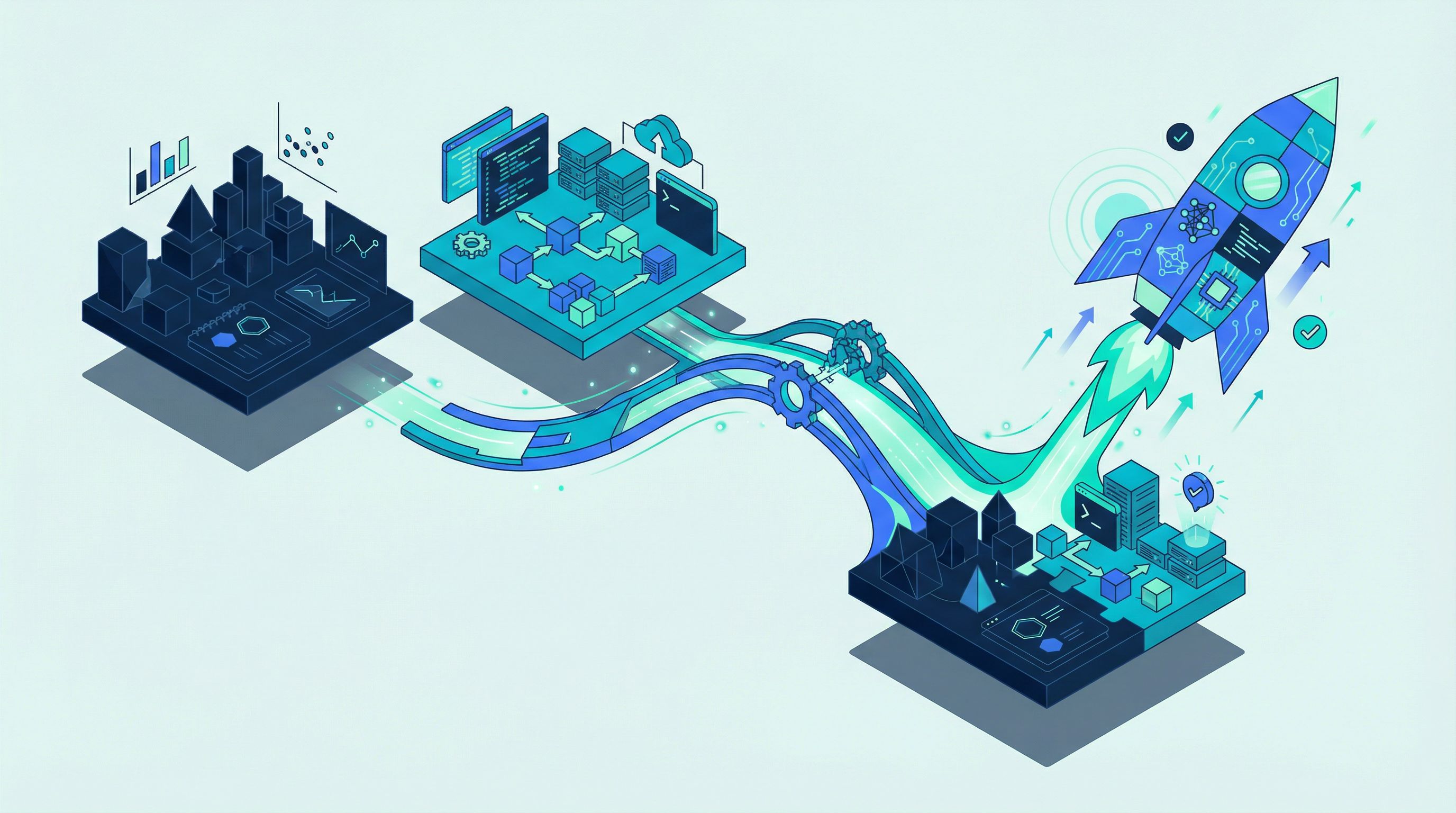
Your Data Scientists can learn software engineering practices. Your Software Engineers can learn ML frameworks. Both can become AI Engineers, professionals who understand models AND production systems, experimentation AND reliability.
The emerging AI Engineer takes different forms. They might be a Data Scientist who learned to ship production code. They might be a Software Engineer who learned LangChain and prompt engineering. They're someone who thinks in systems, not just models. They're someone who ships working software, not just notebooks.
This role already exists at your company. They're just split across two job titles with misaligned incentives.
What Successful AI Teams Look Like Today
The teams winning at AI share common patterns.
First is intense collaboration. No more throwing models over the wall. AI Engineers pair with Product Managers on real customer problems. They work directly with users, iterate fast, and ship constantly.
Second is central product leadership. Someone owns the roadmap and optimizes for business impact, not technical elegance. This leader says "we're shipping a working solution this month, not a perfect one next quarter."
Third is permission to take risks and move fast. AI is probabilistic. You can't spec out every edge case upfront. Successful teams embrace experimentation, A/B testing, and rapid iteration. They ship, measure, learn, and improve.
Fourth is small, autonomous teams. More than ever, small teams can deliver outsized impact. A team of three to four AI Engineers with the right tools like LangChain, vector databases, and LLM APIs can build in weeks what used to take months. Autonomy is critical. These teams need freedom to make technical decisions, choose tools, and iterate based on real user feedback, not wait for committee approval.
Fifth is obsessive customer focus. The winning teams aren't building "AI for AI's sake." They're solving specific, painful customer problems. They talk to users constantly. They measure business metrics, not just model metrics.
The Unfair Advantage of Established Companies
If you're reading this and you already have a product, customers, and deep market understanding, you're sitting on an unfair advantage.
Think about what you have. Real customer problems that AI can solve. Data from actual users, meaning your training corpus is customer behavior. Distribution through existing users who trust you. Domain expertise that lets you understand the nuances that startups miss.
Compare that to what AI-native startups have. A cool demo. Generic solutions looking for problems. No distribution. No domain expertise.
You should be winning. The companies that deeply understand their markets, whether they're mobile gaming studios who know player behavior, FinTech companies that understand risk, or e-commerce platforms with years of transaction data, these companies can leverage AI to create massive competitive advantages.
But only if you adopt the right strategy.
The Real Barriers: Fear and Politics
So why aren't more established companies winning? Two words: fear and politics.
Teams are afraid of change. You hear it constantly. "We've always done it this way." "AI is too risky, too unpredictable." "We need 6 months of testing before we can ship." "What if the model makes a mistake?" Fear is natural. But the bigger risk is moving too slowly while competitors race ahead.
Internal politics kill disruption. The biggest risk to your AI transformation isn't technical. It's organizational. The Data Science team reports to Analytics, with no mandate to ship products. Engineering won't prioritize "experimental" AI features. Product is afraid to commit roadmap to "uncertain" AI timelines. Each VP has their own AI initiative, with no coordination. Procurement requires nine-month vendor reviews for new tools.
Meanwhile, a three-person startup is iterating daily and shipping weekly. This is how incumbents lose.
Change Is Needed. We're Here to Help.
Transforming your team structure, incentives, and culture isn't easy. But it's necessary.
The companies that will win with AI aren't necessarily the ones with the biggest data science teams or the most PhDs. They're the ones that can reorganize around shipping AI products, not researching AI papers. They realign incentives to reward impact, not model accuracy. They retool their teams with modern AI engineering stacks like LangChain, LangGraph, and vector databases. They rethink their culture to embrace experimentation and speed. They remove the politics that block small teams from moving fast.
At Vindler, we've helped companies navigate exactly this transformation. We don't just build AI systems. We help you build AI teams that ship.
Our approach starts with no vibe coding. We bring AI-augmented senior engineers who understand every line, not juniors relying on ChatGPT. We're product-first, solving customer problems instead of building demos. We ship fast, helping you move from months to weeks. We transfer knowledge, training your team instead of creating dependency.
We specialize in LangChain and LangGraph multi-agent architectures. We build RAG systems that actually work in production. We design AWS infrastructure for AI products. We guide team reorganization and upskilling.
If you're an established company with a product, customers, and domain expertise, but you're not moving fast enough on AI, let's talk. The advantage is yours to lose.
Ready to transform your AI team?
Reach out at [email protected], learn more at https://vindler.solutions, or connect with us at https://www.linkedin.com/company/vindler-tech/.